Bee-house update: Roo-house?
11 Tuesday Feb 2014
11 Tuesday Feb 2014
03 Sunday Nov 2013
When we first dug the post holes for the bee house, it was winter. It was a clear, sunny day, but only 30cm underground it was a river. Now, the soil has hardened again and already cracks are forming where the sun has touched between the tussocks. It is the time of insects: the long grass shimmers with the darting of grasshoppers and butterflies, the red gums are awash with ants and centipedes uncurl in dark, hidden places. It’s a good time to introduce our first livestock – bees – and to finally complete their shelter: the Bee House. Continue reading
05 Monday Aug 2013
With our dam now full, one task that’s been on our list since summer is to calculate its approximate capacity to aid with planning our watering infrastructure. We found a couple of possible methods: the Western Australian Department of Agriculture has a very thorough approach, while the Victorian Department of Primary Industries offers a rougher option. We opted for the Victorian method, not least because it offered a chance for us to take our very patriotic inflatable adventure craft out onto the pond.
11 Tuesday Jun 2013
Posted in diy, ecology, regeneration, waterways
With a landscape scarred with a history of erosion, and soil associations that the CSIRO SoilMapp discusses in the most nervous of tones, we’d been apprehensive about this season’s heavy rains. After two days of constant downpours, the water sat on the surface, filled every hollow and started to run in strange new flow patterns along the most unexpected of ridgelines. Neighbours told us they hadn’t seen rain like that for some years, and that erosion headcuts had been reawakened all through the surrounding valleys.
It was a relief to see that our improvised erosion control strategies (use local materials; slow water flow with rock, fallen timber or mulch; always work on contour; get plants in the ground) had all worked to some degree. Indeed, areas where we had made an intervention, however minor, fared much better than areas without. After the dryness of summer it was unexpectedly thrilling to see water flow, vegetation spring up around the branches we stacked across drainage lines, and most of all, creek banks where we’d removed car bodies didn’t slump and be carried off into the neighbouring paddock.
26 Friday Apr 2013
Posted in diy, regeneration, waterways
Tags
erosion, permaculture, planning, reuse, revegetation, soil, trees, water, waterways, winter
We’re celebrating the clean-up of what we call Zephyr Creek, after the 1960s Ford that was wedged at the bottom of the gully. Through the work of a local metal removalist, and a bit of time scrabbling in the mud, most of the major rubbish from the creek has been extracted. Inspired by the amazing work on rainwater harvesting and riparian restoration of Brad Lancaster and organisations like the Quivera Coalition, we’ve implemented our own rustic brand of erosion control. It’s not too pretty, but it is inexpensive (free, in fact) to build and maintain, uses available resources and is easy to alter depending on its effectiveness.
After clearing the rubbish from the creek, we used an A-Frame to measure and mark the contours at two points in the steep bank. We hammered stakes at regular intervals, then built up leaky terraces using scrap construction timber from the gully itself and fallen tree branches. Some of the loose soil promptly settled behind the barriers, and in a few weeks will be planted out with indigenous plants to further stabilise the area.
26 Friday Apr 2013
Posted in ecology
17 Wednesday Apr 2013
Posted in art & craft, diy
After watching the hills turn dry and crispy over the summer, I don’t think I’ve ever pined so much for the return of a little rain, cool weather and a sun not-quite-so-withering, and all the opportunities they bring.
In that spirit, and inspired by the aesthetic of knitted woolly jumpers, I’ve been working on some new images depicting life on the block. I developed them from sketches on isometric graph paper, so each of the elements is actually composed of little equilateral triangles. Among them you may spot Grey Kangaroos, Stubble Quail scattering beneath a harrier and lorikeets zooming overhead. The colour options reference the dry browns of summer and the blue of a big sky and the nearby sea. Continue reading
17 Sunday Feb 2013
Posted in diy, regeneration, waterways

If anyone asks, we’re “agisting ponies”. This terrifying rocking horse oversees one of the rubbish piles.
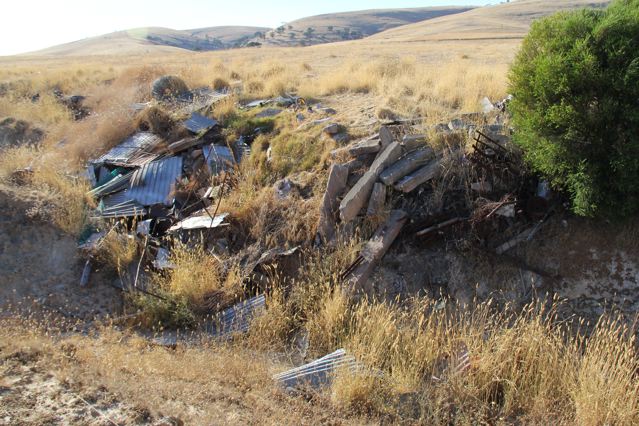
As we’ve noted in our curated collection of farm-found rubbish, the largely idyllic setting of the property masks a narrow badland of erosion gullies repopulated with human trash. It’s bizarre sifting through it, a process of contemporary archaeology that often strays towards the forensic as we imagine the human story behind the array of objects gradually becoming swallowed beneath sediment and phalaris grass.
One of our missions is to clear the large rubbish from the gullies, increasing their habitat value and allowing us to more effectively address erosion and revegetation, while also allowing for the reuse and recycling of the accumulated items. On a blazing February morning, we helped a local scrap dealer begin to extract recyclable metal from one of the most dramatically eroded gullies. In an hour and a half we had well over a tonne of metal, in the form of a deep freeze (packed with coral, rainbow-coloured aquarium stones and empty tins of bourbon and cola), two washing machines, an electric oven and stove, a motorbike, three BMX bikes, an exercise bike, venetian blinds, chook wire, corrugated iron, steel tubing, downpipes, engine parts, metal drums, wheel rims and homemade farm machinery. Continue reading
15 Tuesday Jan 2013
Posted in planning
Tags
ecology, erosion, kangaroos, permaculture, planning, revegetation, soil, summer, trees, water
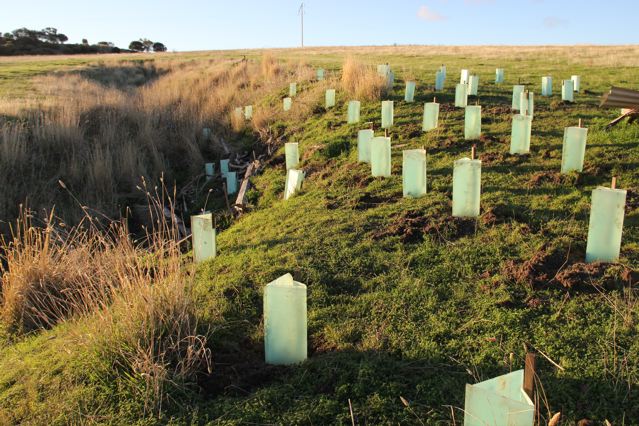
Strangely, one of the things that attracted us to this particular patch of ground was its need for regeneration. With only three established trees on all 47 acres, one of our first projects is to plan revegetation in an attempt to return areas of the landscape to a reflection of the Pink Gum Woodland it likely was 180 years ago.
In the spirit of the permaculture principle of observation before action, we’ve been restraining our compulsion to do stuff to instead spend the first year or so primarily attempting to learn the patterns of the landscape, auditing what’s here and reflecting on possibilities before we start digging holes. Continue reading