• About
  • Anacotilla: History & Hearsay
  • Junk: A Curated Collection
  • Resources
  • Species List
  • Yarnauwingga and beyond

Yarnauwi Farm

~ Fleurieu Peninsula, South Australia

Yarnauwi Farm

Tag Archives: seasons

Planting and preparing trees for El Niño

09 Tuesday Jun 2015

Posted by Joel in diy, ecology, propagation, regeneration, trees

≈ 3 Comments

Tags

ecology, farm, kangaroos, permaculture, planning, propagation, revegetation, seasons, southwestern Fleurieu, trees, water, winter

IMG_6330

A baby, or a nest, are not essential for tree-planting, but they help.

We’re in our third season of tree planting at Yarnauwi now, working to revegetate sections of the property for habitat, shelter and timber. We’ve planted about 1,000 plants a year, from groundcovers to future woodland giants. Once they were guarded from marauding roos, we’ve necessarily had a philosophy of leaving the plants to survive without too much intervention. Even in a dry year such as 2014, we had a modest 60ish percent survival rate, but with El Niño tipped to recur in 2015, we’ve tried to further refine our approach to give our trees an improved chance of survival. Of course, there are absolutely no guarantees it will work, or will work for everything, but it’s worth a shot.

IMG_6328

The bunyip water level: bringer of contoured joy to young and old alike.

This year, we’ve also planted our first, experimental, woodlot of river oaks (Casuarina cunninghamiana) in an awkward corner of the farm. The paddock was too small and inaccessible to deep rip, so we began by marking contours with a bunyip water level, an essential DIY tool for measuring and marking slope (see Brad Lancaster’s guide to bunyip construction and usage here).  Continue reading →

A break in the season

15 Wednesday Apr 2015

Posted by Joel in ecology, regeneration, trees, waterways

≈ Leave a comment

Tags

ecology, farm, photography, revegetation, seasons, southwestern Fleurieu, summer, trees, water, waterways

IMG_6090

The rain gauge almost full!

With the big rains of the last couple of weeks, it feels like we’re approaching an break in the seasons. In most parts of the property, the cracks that open in the clay over summer are softening and closing, and there’s a green fuzz of new growth on the ground (especially in the areas with existing, dry ground cover, we’ve noticed). The sheep march briskly between discoveries of fresh grass and happily fan out over new paddocks.

IMG_6093

A self-sown red gum pushes through the cracks.

Continue reading →

The last rays of summer

11 Wednesday Mar 2015

Posted by Joel in ecology

≈ 6 Comments

Tags

photography, sea, seasons, southwestern Fleurieu, summer, water

IMG_5790

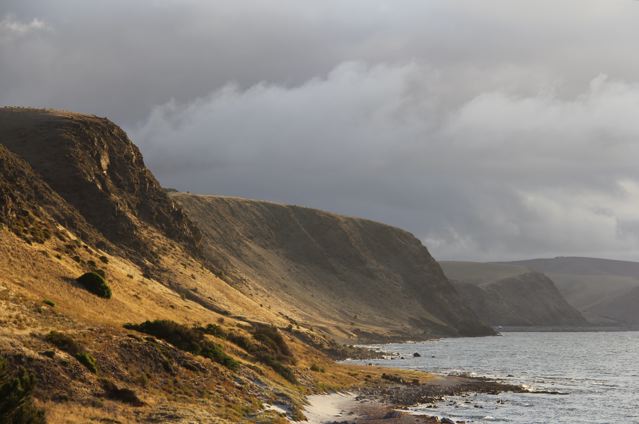
The magic hour hits the cliffs at Lady Bay.

It’s now officially autumn, and already the air feels a little different. There’s a cool edge to the mornings, and a hint of moisture to the air. The land still feels dry, but we tell ourselves it won’t be long now.

IMG_5793

Light on the Little Gorge, Lady Bay

Continue reading →

Maintain the rain! Piecing together the past to imagine a future

05 Thursday Mar 2015

Posted by Joel in ecology, history, planning, regeneration, trees, waterways

≈ 2 Comments

Tags

art, ecology, erosion, farm, history, livestock, photography, planning, revegetation, seasons, soil, southwestern Fleurieu, summer, trees, water, waterways, winter

It’s been a dry year on the Fleurieu Peninsula. After the inundation of 2013, 2014’s rainfall came in almost 200mm shy of the year before, and about 100mm short of the average. By February 2015, the dam had receded to a few centimetres of sludge, and the water carter had come to top up the stock water tanks. While there’s no doubt that the Fleurieu Peninsula has had the Mediterranean pattern of dry summers and cool, wet winters for some time, recently I’ve begun to wonder whether this pattern has shifted towards greater aridity as successive land-uses have cleared the landscape.

Curruckalinga, looking over St. Vincent’s Gulf, 1846, George French Angas, depicting a mosaic of woodland and open grassland. From the description: “This view is taken from the rocky hills near Mr Kemmis’s Station, to the northward of Rapid Bay … The undulating appearance of the country here represented, together with the singular manner in which the trees are dotted about in all directions over the landscape … principally ‘casuarinae’ or she-oak, with ‘eucalyptus’.” From the collection of the State Library of South Australia, B15276/33.

At the time of European colonisation, the Fleurieu Peninsula was most likely covered with a mosaic of woodland, forest and grasslands, maintained through Aboriginal burning and land management practices. In his paper on the discovery and settlement of the Fleurieu (1986), Rob Linn draws from the diaries of settlers in his descriptions of the landscape of the South Western Fleurieu. Writing in 1838, William Giles described the landscape around Rapid Bay, as “a most beautiful valley, the soil of great depth covered with most luxuriant herbage … on the sides of these hills we found plenty of keep for sheep, and wherever the grass had been burnt in these places it was looking beautifully verdant … fine land, excellent water, plenty of timber …” This was echoed by John Stephens in 1839, describing the “country from Cape Jervis upwards” as “very picturesque” and “well-timbered” (Linn 1986). Continue reading →

Testing water quality

27 Tuesday Jan 2015

Posted by Joel in ecology, planning, regeneration, tools, waterways

≈ Leave a comment

Tags

design, ecology, farm, permaculture, planning, seasons, southwestern Fleurieu, summer, water, waterways

IMG_5573

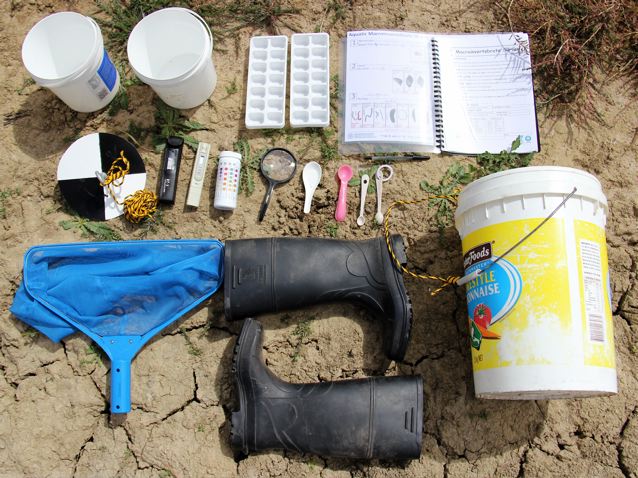
The DIY water testing kit, including big buckets, little buckets, ice-cube trays, teaspoons, magnifying glass, pH strips, homemade Secchi disk, EC meter, pool net, boots, ID charts and recording sheets. If you have a toddler in attendance, you may consider a change of clothes for yourself and toddler.

Inspired by permaculture’s commitment to observation, over the last couple of years, we’ve become enthusiastic/compulsive gatherers of data about our farm. Everything we can think of to measure, we’ve tried to measure. Now, as we scale up our interventions, we can begin to track our impact and refine our management accordingly. As part of this, we’ve started a seasonal water quality testing program to monitor changes in the quality of our catchment as we revegetate the catchment and manage grazing more intensively.

We’ve assembled our own water testing kit, all stored conveniently in a secondhand mayo bucket from the local chip shop. Using this, there are a few characteristics we’ll test seasonally:

  • salinity and temperature (both tested using an EC (Electrical Conductivity) Meter from your friendly local hydroponics vendor),
  • pH (tested using pool pH strips from the hardware shop),
  • turbidity is a measure of the amount of solids suspended in the water (measured with a DIY Secchi disk or turbidity tube),
  • macroinvertebrate populations, the presence and composition of which is also an indicator of pollution levels (gathered with buckets and nets, and sorted with teaspoons into ice-cube trays).

Continue reading →

Fleurieu Foliage: River red gum (Eucalyptus camaldulensis)

19 Monday Jan 2015

Posted by Joel in ecology, propagation, regeneration

≈ 5 Comments

Tags

bees, books, ecology, farm, nursery, propagation, revegetation, seasons, southwestern Fleurieu, summer, trees, water

IMG_5468

After shedding two-thirds of its branches last year, one of our giant red gums is now a forest of new shoots.

As the two remnant trees on our farm, River red gums (Eucalyptus camaldulensis) hold a special place in our hearts. Our red gums are bent and stretch up the hillside away from the prevailing winds. Red gums are not unique to the Fleurieu however, in fact, their high level of adaptability means that they have a distribution across Australia, most commonly occurring on floodplains and waterways as well as throughout higher rainfall regions.

IMG_5466

Not dead yet! After apparently dying in an unusually dry winter and spring, this year-old red gum seedling has re-sprouted from its base after receiving about 10mm of rain over several weeks.

With red gums as a significant species in the past ecosystem of our property, they’ve been a clear choice for revegetation. When planting, we’re constantly inspired by their resilience. I’ve heard it said that red gum roots grow at a centimetre a day, which puts them at over three-and-a-half metres a year. If it’s true, then it’s an indicator of their startling ability to find water and nutrients. We’ve been amazed by some of our red gums that have shot to almost 1.5 metres after a couple of years in the ground, but also by their apparent capacity for dormancy. Some seedlings will sit in dry, cracked clay soil for months on end, leaves green but not growing. Then, with a decent rain, they burst into new growth. Likewise, others appear to have died, leaving nothing but a dry stick until the opening rains of autumn when they reshoot from the ground, sending out a profusion of leaves and spindly branches. We’ve noticed some other plants behave similarly – the occasional melaleuca or acacia for example – but none so consistently and successfully resurrect themselves as the red gum.

Continue reading →

Visions of the Past: historical photos of Anacotilla

15 Thursday Jan 2015

Posted by Joel in history

≈ Leave a comment

Tags

Anacotilla, farm, history, photography, seasons, southwestern Fleurieu, trees, waterways, winter

4567. Anacotilla Bridge

Anacotilla Bridge on Main South Road, with Lorna Kelly (riding side saddle), E.C. and G.F. Kelly (c1896). Image courtesy of the Yankalilla & District Historical Society.

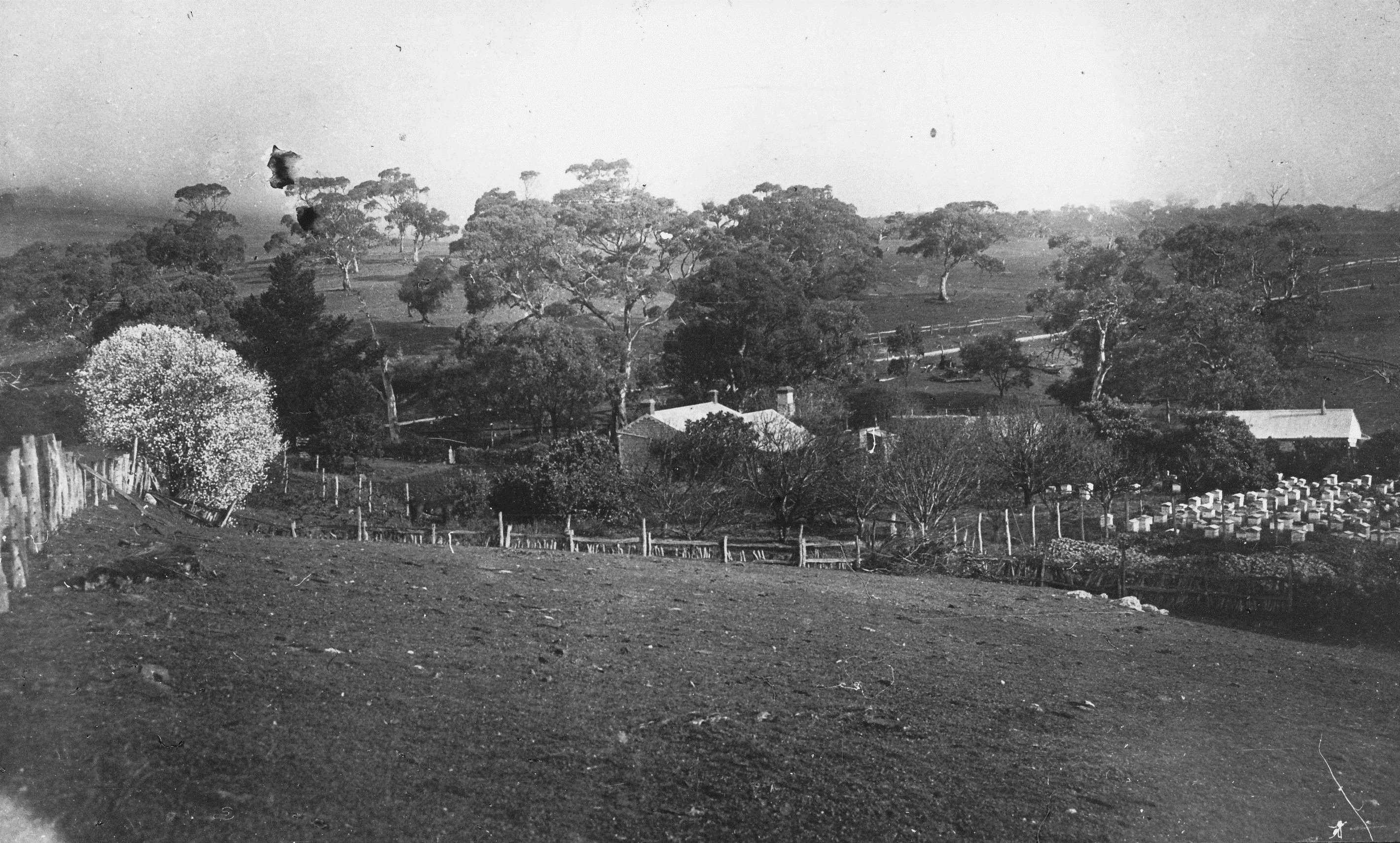
Our farm, Yarnauwi, is one lot of the once expansive Anacotilla pastoral property. Just over the ridge, in the Anacotilla river valley, are the old workers’ cottages, and on the hillside opposite, the sprawling homestead and outbuildings. We’ve recently been corresponding with the Yankalilla and District Historical Society about our interest in the property’s history, and they shared with us a number of photographs from the late 1800s onwards.

4563. Anacotilla

“Anacotilla”, Second Valley, home of A.C. Kelly in the 1880s. Image courtesy of the Yankalilla & District Historical Society.

IMG_5348

The Anacotilla cottage and outbuildings, 2014, viewed from Main South Road, near Paradise Drive. While the cottage has undergone substantial additions and renovations, the original two-room dwelling still exists at its centre.

Continue reading →

Gathering storm

11 Sunday Jan 2015

Posted by Joel in ecology

≈ 3 Comments

Tags

farm, photography, seasons, southwestern Fleurieu, summer, water

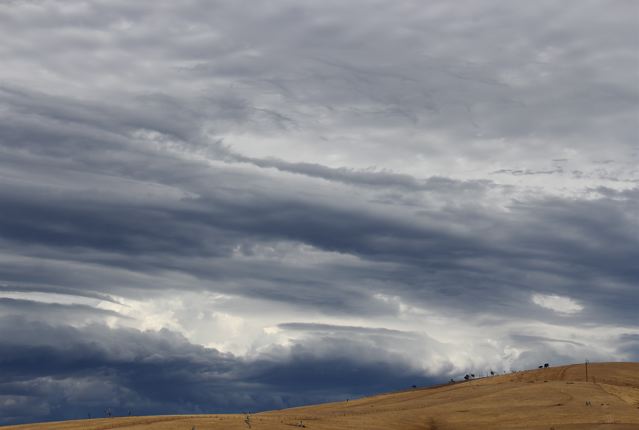
IMG_5475After a dry 2014, storm clouds gather, offering the chance of record summer rainfalls for parts of South Australia.
Continue reading →

Alpaca makeover: our first shearing

08 Thursday Jan 2015

Posted by Joel in livestock

≈ 2 Comments

Tags

alpacas, craft, farm, livestock, seasons, southwestern Fleurieu, summer, textiles

IMG_5478

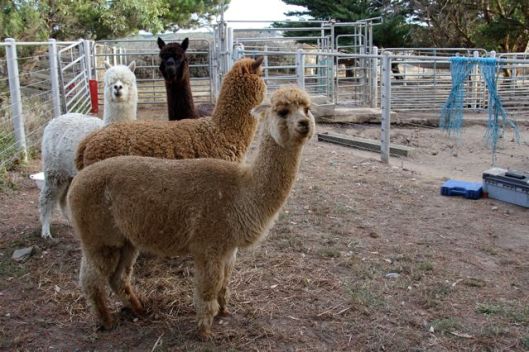
The before shot: full-coated alpacas from Yarnauwi and Whistling Pig mingle before their makeover.

Our alpacas Fidel and Ernesto have tolerated the heat for some weeks now, so there was general celebration when their shearing day arrived. Unfortunately, it also happened to be a searing, humid afternoon when we attempted to load them onto the trailer to transport them down the road to Delamere’s stunning Whistling Pig Farm where the shearers would meet us and clip our respective animals. In the past, we’ve thought of Fidel and Ernesto as compliant, if a little aloof, but that afternoon, with the sun beating down, they flatly refused to step aboard the trailer. We bribed, cajoled, pushed and persuaded in every way we could think of, but they just sat down in the grass, leaned against the trailer tailgate, and ignored us. Thankfully, the shearers were passing, and in a matter of seconds had them aboard on their way to Whistling Pig.

IMG_5483

Ernesto takes a professional interest in Fidel’s trim. 

Continue reading →

The Farm Year in Review: 2014

18 Thursday Dec 2014

Posted by Joel in events, livestock, planning, regeneration

≈ 6 Comments

Tags

design, ecology, events, farm, fencing, food, hiking, livestock, permaculture, planning, propagation, revegetation, seasons, sheep, southwestern Fleurieu, summer, tractor, water, winter, zones

2014 was a year where the dry season came early and stayed late. It seemed as if the rain barely had a chance to soften the ground and throw up some soursobs before our clay soils began to crack again and the pasture browned off. Despite this, after two years observing the rhythms of this patch of ground, I feel like we’re becoming more resilient and optimistic: where previously we despaired at every lost seedling, now we celebrate every survivor.

shingleback

Summer: a shingleback lizard soaks up some sunshine.

In the spirit of permaculture, this year also marks a transition from our observational period towards beginning to implement infrastructure for a sustainable farming enterprise. With fencing and water infrastructure for livestock, our appreciation of the need for water only deepens, and despite its challenges, we’ve learnt to stop worrying and love winter.

Continue reading →

← Older posts
Newer posts →

Yarnauwi on Etsy

Enter your email address to follow this blog and receive notifications of new posts by email.

Join 223 other subscribers

What We’re Writing About

alpacas annual report art art and craft bees before and after birds books building cheese climate change craft damara design downloads ecology embroidery erosion etsy events farm fencing fire Fleurieu Fleurieu Coast Fleurieu Peninsula food fungi future hack hiking history illustration insects kangaroos leather leathercraft linoprint livestock logo nursery permaculture photography picnics planning plants Plastic-free July printing propagation rain recycling regeneration regenerative agriculture reuse revegetation sea seasons seeds shed sheep sheepskins shop soil southwestern Fleurieu stiles summer textiles tractor trees ute waste water waterways winter zones

Meta

  • Create account
  • Log in
  • Entries feed
  • Comments feed
  • WordPress.com

Blog at WordPress.com.

  • Subscribe Subscribed
    • Yarnauwi Farm
    • Join 223 other subscribers
    • Already have a WordPress.com account? Log in now.
    • Yarnauwi Farm
    • Subscribe Subscribed
    • Sign up
    • Log in
    • Report this content
    • View site in Reader
    • Manage subscriptions
    • Collapse this bar
 

Loading Comments...