• About
  • Anacotilla: History & Hearsay
  • Junk: A Curated Collection
  • Resources
  • Species List
  • Yarnauwingga and beyond

Yarnauwi Farm

~ Fleurieu Peninsula, South Australia

Yarnauwi Farm

Category Archives: waterways

The Salvage Season

23 Monday Mar 2015

Posted by Joel in art & craft, ecology, history, regeneration, waterways

≈ Leave a comment

Tags

art, ecology, erosion, farm, history, photography, southwestern Fleurieu, waste, waterways

IMG_5900_2

The steely gaze of a doll, complete with an electrical tape necklace.

With the chilling of the air, it’s time for us to don our gloves and get stuck into mining the junk that lines the banks and bed of our erosion gullies. It’s become an annual tradition to pick a path through chest-high phalaris, filling bags with debris. It’s scratchy, dusty work, with plastic milk bottles and the remains of plastic bags collapsing into confetti with the gentlest of touches. Yet despite the discomfort, we can’t help but have a forensic fascination with what we unearth. Each discovery is a cryptic clue into the lives of our predecessors, those who decided that the headwaters of a creek would be the best place for their unwanted bric-a-brac.

IMG_5889

A broken clock amid bones. We’ll leave you to come up with your own metaphors.

Continue reading →

Maintain the rain! Piecing together the past to imagine a future

05 Thursday Mar 2015

Posted by Joel in ecology, history, planning, regeneration, trees, waterways

≈ 2 Comments

Tags

art, ecology, erosion, farm, history, livestock, photography, planning, revegetation, seasons, soil, southwestern Fleurieu, summer, trees, water, waterways, winter

It’s been a dry year on the Fleurieu Peninsula. After the inundation of 2013, 2014’s rainfall came in almost 200mm shy of the year before, and about 100mm short of the average. By February 2015, the dam had receded to a few centimetres of sludge, and the water carter had come to top up the stock water tanks. While there’s no doubt that the Fleurieu Peninsula has had the Mediterranean pattern of dry summers and cool, wet winters for some time, recently I’ve begun to wonder whether this pattern has shifted towards greater aridity as successive land-uses have cleared the landscape.

Curruckalinga, looking over St. Vincent’s Gulf, 1846, George French Angas, depicting a mosaic of woodland and open grassland. From the description: “This view is taken from the rocky hills near Mr Kemmis’s Station, to the northward of Rapid Bay … The undulating appearance of the country here represented, together with the singular manner in which the trees are dotted about in all directions over the landscape … principally ‘casuarinae’ or she-oak, with ‘eucalyptus’.” From the collection of the State Library of South Australia, B15276/33.

At the time of European colonisation, the Fleurieu Peninsula was most likely covered with a mosaic of woodland, forest and grasslands, maintained through Aboriginal burning and land management practices. In his paper on the discovery and settlement of the Fleurieu (1986), Rob Linn draws from the diaries of settlers in his descriptions of the landscape of the South Western Fleurieu. Writing in 1838, William Giles described the landscape around Rapid Bay, as “a most beautiful valley, the soil of great depth covered with most luxuriant herbage … on the sides of these hills we found plenty of keep for sheep, and wherever the grass had been burnt in these places it was looking beautifully verdant … fine land, excellent water, plenty of timber …” This was echoed by John Stephens in 1839, describing the “country from Cape Jervis upwards” as “very picturesque” and “well-timbered” (Linn 1986). Continue reading →
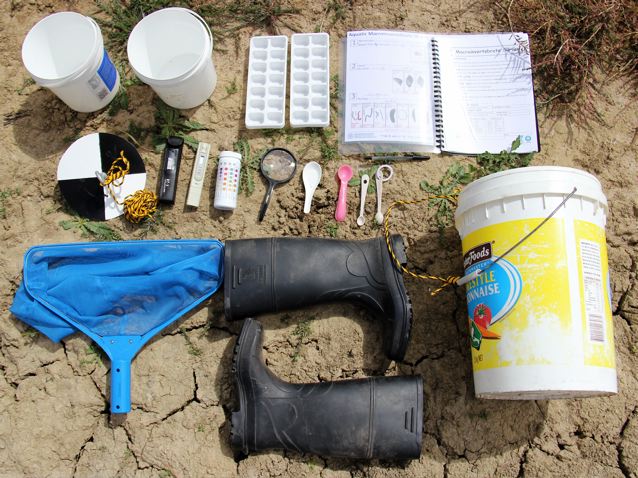
Testing water quality

27 Tuesday Jan 2015

Posted by Joel in ecology, planning, regeneration, tools, waterways

≈ Leave a comment

Tags

design, ecology, farm, permaculture, planning, seasons, southwestern Fleurieu, summer, water, waterways

IMG_5573

The DIY water testing kit, including big buckets, little buckets, ice-cube trays, teaspoons, magnifying glass, pH strips, homemade Secchi disk, EC meter, pool net, boots, ID charts and recording sheets. If you have a toddler in attendance, you may consider a change of clothes for yourself and toddler.

Inspired by permaculture’s commitment to observation, over the last couple of years, we’ve become enthusiastic/compulsive gatherers of data about our farm. Everything we can think of to measure, we’ve tried to measure. Now, as we scale up our interventions, we can begin to track our impact and refine our management accordingly. As part of this, we’ve started a seasonal water quality testing program to monitor changes in the quality of our catchment as we revegetate the catchment and manage grazing more intensively.

We’ve assembled our own water testing kit, all stored conveniently in a secondhand mayo bucket from the local chip shop. Using this, there are a few characteristics we’ll test seasonally:

  • salinity and temperature (both tested using an EC (Electrical Conductivity) Meter from your friendly local hydroponics vendor),
  • pH (tested using pool pH strips from the hardware shop),
  • turbidity is a measure of the amount of solids suspended in the water (measured with a DIY Secchi disk or turbidity tube),
  • macroinvertebrate populations, the presence and composition of which is also an indicator of pollution levels (gathered with buckets and nets, and sorted with teaspoons into ice-cube trays).

Continue reading →

Regeneration: Two years of practising patience

16 Sunday Nov 2014

Posted by Joel in ecology, planning, regeneration, trees, waterways

≈ 4 Comments

Tags

before and after, ecology, erosion, farm, fencing, kangaroos, permaculture, planning, propagation, revegetation, seasons, southwestern Fleurieu, trees, waste, waterways

IMG_5332

Some might consider Shark-mesh overkill for allowing rushes to regenerate.

In our first year of working on the farm, we really tried to practise the permaculture principle of long and thoughtful observation, but it always competed with our own impatience to see change. In that first flurry of clearing gullies and planting seedlings, I remember trawling the internet for before-and-after shots of other people’s reveg projects: something to help imagine a future for the block. Seasoned tree-planters told us we’d see real change in five years, the optimistic suggested three, others, fifteen.

PycnanthaRegen

Self-regenerating golden wattle (Acacia pycnantha) after two years, and protection from kangaroos. This wattle was one of four trees present on the entire property in 2012.

Now at the two year mark, we are noticing change. Removing cattle and fencing sensitive areas has allowed a fuzz of groundcover to begin growing over the barest of gullies. Fences have reoriented deer and kangaroo movement and grazing patterns. Some seedlings planted in the cold, soggy winter of 2013 appeared to die, but then surprised us by resprouting and growing at a cracking pace the following autumn. Other plants that were repeatedly pruned back to their tree-guard height by roos have invested their growing energy into roots and woody stems.

Continue reading →

How many swallows make a summer?

10 Friday Oct 2014

Posted by Joel in ecology, waterways

≈ Leave a comment

Tags

birds, ecology, farm, photography, seasons, southwestern Fleurieu, summer, water

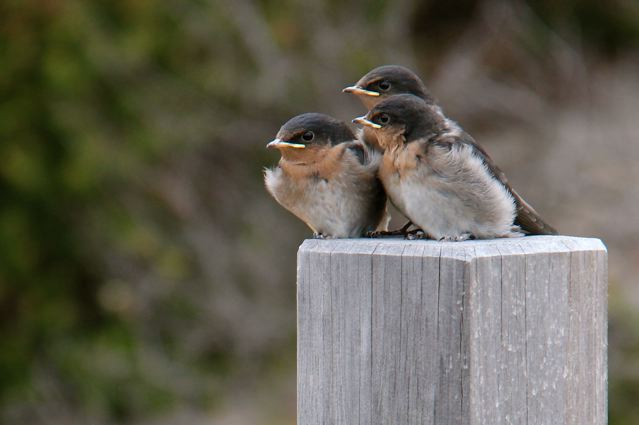
welcomeswallowFlocks of Welcome Swallows (Hirundo neoxena) have been hunting on our farm for months now, spiralling around us as we work, then resting as a group along the fences. They are amazingly acrobatic hunters, plucking insect prey from the air in circles and dives. Apparently, swallows need to eat their own body weight every day to maintain their health. While they weigh only 10 grams, this can mean they can eat up to 400 times a day (approximately every two minutes) to ensure their sprightliness.

Young welcome swallows huddle together at Seal Bay, Kangaroo Island (October 2014).

Young welcome swallows huddle together at Seal Bay, Kangaroo Island (October 2014).

Over the last month or so, we’ve spotted swallows hunting over the dam on a couple of occasions. They circle, dive and appear to be plucking prey from just below the surface of the water. If they are hunting sub-surface prey, according to birder Jennifer Spry, this is a largely undocumented phenomenon. These photos are a little too indistinct to say for sure, but interesting nonetheless! Continue reading →

Erosion control: 15 months on

22 Tuesday Apr 2014

Posted by Joel in ecology, planning, regeneration, waterways

≈ Leave a comment

Tags

design, ecology, erosion, planning, seasons, soil, southwestern Fleurieu, summer, water, waterways

One of the first interventions we made on the property was trying out some very rough erosion control on this scoured patch on our boundary. Earthworks from recent fencing had disturbed the soil and invited headcuts to form. With help from Pete and Freya, we tentatively set up a couple of lo-fi erosion strategies, informed by the work of Watershed Artisans (formerly Dryland Solutions) and Brad Lancaster, both of whom we’ve gushed about before. We reshaped the main headcut to soften the overflow, and positioned some kind of mutant One Rock Dam/Zuni Bowl at an intersection between two small headcuts – not something I’d do again. We also positioned a One Rock Dam on contour above the entire area in an effort to slow and disperse water flow.

IMG_1970

A scoured, erosive patch, December 2012.

Continue reading →

Pipe Dreams: How to set up a watering system for stock

22 Tuesday Apr 2014

Posted by Joel in diy, livestock, planning, waterways

≈ 2 Comments

Tags

building, design, livestock, planning, seasons, southwestern Fleurieu, summer, water, winter

‘Pipe Dream’: useful for passing time in the late 1980s, not that useful for planning livestock systems.

One of our key milestones in the development of the property this year was the establishment of a watering system for livestock. Having a watering system supports our fencing of the farm dam and waterways for habitat regeneration and also allows us to more intensively manage the movement and impact of livestock through rotational grazing. While we’re still the furthest thing from expert, with the advice and support of our neighbours, we managed to knock together a watering system that works. In researching and developing our own plans, we found an absence of basic information on setting up stock systems, so the ideas below are a few of the things we learnt or found useful in planning a system for our own context and landscape. They are just one perspective in informing your own planning, and shouldn’t be read as an endorsement of any particular way of doing things.

Continue reading →

A One-Page Place Assessment for TBC Farm, Second Valley

30 Sunday Mar 2014

Posted by Joel in ecology, planning, regeneration, waterways

≈ 2 Comments

Tags

books, design, ecology, permaculture, planning, revegetation, seasons, soil, southwestern Fleurieu, trees, water, waterways

Brad Lancaster’s books on Rainwater Harvesting would have to be among the most consistently inspiring books we own. Two volumes into his trilogy on Rainwater Harvesting for Drylands and Beyond, Lancaster combines accumulated community wisdom with permaculture principles to produce lavishly illustrated, practical and highly accessible manuals for managing water in urban and rural environments. Consistent with permaculture thinking, Lancaster urges land managers to spend time observing the season patterns of the landscape to more effectively design for sustainable, integrated water management. One method of doing this is to compile a One Page Place Assessment, drawing together essential climatic and ecological information about your particular location.

Our first year has been one of spreadsheets, mapping out our seasonal observations and activities, and the One Page Place Assessment concept is a elegant way of compiling climatic data from Second Valley and the surrounding area. We’ve finally completed the first version of a place assessment for our property, with much of the data drawn from Bureau of Meteorology stations nearby (Myponga Reservoir being the furthest). While we have tailored information to our particular location, we hope it will be of use to other landowners in the region. We have also referenced information sources so others can draw on the same resources in exploring their own area.

You can download our One Page Place Assessment here. Continue reading →

The Picnic at the End of the World: Farm Clean Up Day

10 Monday Mar 2014

Posted by Joel in diy, events, regeneration, waterways

≈ Leave a comment

Tags

erosion, events, history, picnics, reuse, seasons, southwestern Fleurieu, summer, waste, waterways, winter

Hauling junk is over-represented on this blog. Despite how often we allude to it, cleaning up piles of scrap has steadily been slipping down the list of ‘things-to-do’ in favour of the million other farm jobs. So this year, to keep motivated, we registered as an official Clean Up Australia Day site.

IMG_3633

The Picnic at the End of the World: Morning tea at Ground Zero

The day was windy, marking the shift back towards winter, and as we set to work, two Wedge-tailed Eagles circled above, one harassed by the resident family of magpies while the other lazily surfed the thermals. After the burst of heavy rain a couple of weeks ago, already fresh new grass is emerging. Continue reading →

Clearing the Junk (aka. Ute-based Art)

19 Sunday Jan 2014

Posted by Joel in art & craft, regeneration, waterways

≈ Leave a comment

Tags

art, erosion, history, recycling, reuse, ute, waste, waterways

IMG_3569_2

“Tangents in the landscape” (detail), 2014, mixed media installation, fencing wire, ratchet straps and Holden Rodeo ute

A day spent hauling junk out of gullies can put you in a philosophical mood. When we first purchased this property, we were drawn to the erosion gullies filled with generations of farm rubbish with a kind-of masochistic fascination. After a year of hauling, stacking and shunting loads to the dump or recycling depot, today we loaded up our ute with the final bundles of unruly and ancient fencing wire.

IMG_3413

Bye-bye horror horse!

The most recent round of dump trips has also been momentous in that it finally marks the banishment of a terrifying, rusted and threadbare rocking horse from the property. The horror horse, wedged between rusted 44-gallon drums stuffed with irrigation pipe and topped with a decaying mattress, formed one in a series of mobile art installations mounted on the back of the ute, displayed for a brief, one-time-only journey between our block and the Yankalilla dump. A number of more conceptual, minimalist pieces followed shortly after, composed of snarls of fencing wire of assorted vintage. Continue reading →

← Older posts
Newer posts →

Yarnauwi on Etsy

Enter your email address to follow this blog and receive notifications of new posts by email.

Join 223 other subscribers

What We’re Writing About

alpacas annual report art art and craft bees before and after birds books building cheese climate change craft damara design downloads ecology embroidery erosion etsy events farm fencing fire Fleurieu Fleurieu Coast Fleurieu Peninsula food fungi future hack hiking history illustration insects kangaroos leather leathercraft linoprint livestock logo nursery permaculture photography picnics planning Plastic-free July printing propagation rain recipes recycling regeneration regenerative agriculture reuse revegetation sea seasons seeds shed sheep sheepskins shop soil southwestern Fleurieu summer textiles tour tractor trees ute waste water waterways winter zones

Meta

  • Create account
  • Log in
  • Entries feed
  • Comments feed
  • WordPress.com

Blog at WordPress.com.

  • Subscribe Subscribed
    • Yarnauwi Farm
    • Join 223 other subscribers
    • Already have a WordPress.com account? Log in now.
    • Yarnauwi Farm
    • Subscribe Subscribed
    • Sign up
    • Log in
    • Report this content
    • View site in Reader
    • Manage subscriptions
    • Collapse this bar
 

Loading Comments...