• About
  • Anacotilla: History & Hearsay
  • Junk: A Curated Collection
  • Resources
  • Species List
  • Yarnauwingga and beyond

Yarnauwi Farm

~ Fleurieu Peninsula, South Australia

Yarnauwi Farm

Tag Archives: waterways

Going plastic free in July

06 Monday Jul 2015

Posted by Joel in ecology, regeneration

≈ 3 Comments

Tags

ecology, farm, Plastic-free July, recycling, reuse, southwestern Fleurieu, waste, water, waterways
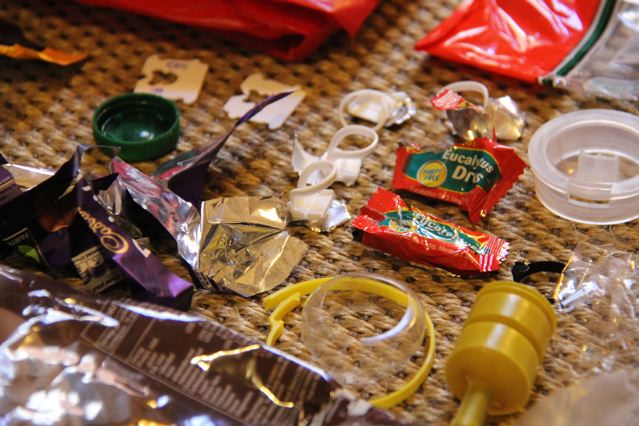
IMG_6528

Some of the treasures accumulated in a month of auditing our plastic waste.

A side effect of working to restore our gullies from rubbish dumps to some version of a functional waterway is that we’ve become a bit twitchy about waste. We’re constantly surprised at the kinds of things that have ended up pushed over the banks. We’ve written before about discoveries like the garbage bags filled with empty recyclable milk bottles that implode into confetti after being in the elements for a decade, or the long-expired discount cards for long-bankrupt franchises preserved by their plastic lamination. Perhaps there’s no more weirdly poetic illustration of the persistence of plastic waste than the discovery of a midden of ‘disposable’ nappies, their contents long composted, but the nappy itself only slightly aged by the elements.

Inspired by the Normanville Natural Resource Centre‘s call to attempt a ‘Plastic-Free July‘, this month we’ll be experimenting with further reducing our production and usage of single-use plastics. Working to reduce our plastic usage is topical not just because of our gully dumps, but also because of our proximity to the ocean. You don’t have to walk for very long along the tideline just a kilometre or so from our back boundary to turn-up a few handfuls of neon micro-plastics that have tumbled on the currents for years. As the Catalyst feature Plastic Oceans demonstrates below, plastic ‘marine debris’ is an unfortunate illustration of the ecological law that “everything must go somewhere”, that there is no “away” to which things can be thrown. Continue reading →

Landscape history and future planning

30 Thursday Apr 2015

Posted by Joel in ecology, history, planning

≈ 9 Comments

Tags

design, ecology, erosion, farm, history, kangaroos, livestock, permaculture, planning, revegetation, soil, southwestern Fleurieu, trees, water, waterways

Recently we’ve been obsessing a bit about the history of our landscape (here, here, and even here, for example). It comes as the consequence of the last few years of reading and thinking about how Australia’s landscape and water systems have changed over time, but we hope it’s not purely an intellectual exercise. Understanding how our landscape was 200 years ago acts as a good guide for planning its future potential and limitations. By attempting to unravel the threads of actions and consequences that have reshaped these hills and valleys over the last couple of centuries, we can also not just address symptoms (such as treating an erosive headcut with a Zuni Bowl), but can also have a go at working on the causes of dysfunction in our soil, water and ecosystems. A lofty goal, but as Wes Jackson quips, “if your life’s work can be accomplished in your lifetime, you’re not thinking big enough!”

Landscape History - New Page

This spaghetti-and-meatballs flowchart is our first go at representing what might have happened in our neighbourhood over the last 180-odd years, compiled from reading, observations, historical records and discussions. It provides us with a list of things to do as we attempt to address elements of this (for example, in this year’s tree planting, we’re inoculating our seedlings with beneficial fungi to restore mycorrhizal networks). We expect this chart to be tweaked, adjusted and rewritten over time as we discover new ideas or revise our assumptions. Perhaps a next step might be to construct a sequel that shows how we might attempt to improve some of this stuff.

Are there connections, consequences or other things we’ve missed, overstated or got plain wrong? We’d love to hear your thoughts and ideas.

Book review: Restoring rivers with ‘Let the Water Do the Work’

26 Sunday Apr 2015

Posted by Joel in ecology, regeneration, reviews, waterways

≈ 3 Comments

Tags

books, design, ecology, erosion, farm, permaculture, soil, southwestern Fleurieu, water, waterways

1950-ltwdtw-i

Weirdly, one of the elements we found appealing about our property was the erosion. In a fit of masochistic optimism, we were excited by the prospect of working to restore a degraded landscape to a level of ecological function, of seeing gully walls stabilised with plants and creeklines resounding with a froggy chorus. As we’ve explored the best strategies for managing and restoring these sections of the property, the advice we’ve received has often tended towards paying someone to think about it and do the work for us, purchasing expensive, industrially produced tools and materials, and utilising heavy machinery, all of which bring with them a substantial price tag. This disturbed us, because it seems to suggest that land restoration is the domain of those with cash to splash, and that those people or places without the necessary resources may just have to resign themselves to the continued collapse of their landscapes.

Thankfully, we came across the work of the likes of Craig Sponholtz, Brad Lancaster, Bill Zeedyk and Van Clothier, and in Australia, Cam Wilson and Peter Bennett. In their work, these thinkers and practitioners of water management and restoration, offer a radically different approach to watershed restoration. While they don’t flinch from the importance of technical understanding, they cultivate strategies that are based in the thoughful observation of those who are connected to a landscape, that utilise locally available materials, and that draw on community power to create modest interventions that can be tweaked over time. Rather than advising that landowners simply save up and pay an expert, their work seeks to empower communities to manage, monitor and maintain water in their landscapes through accessible, practical and locally-adaptable erosion control and water harvesting responses. In his foreword to Zeedyk and Clothier’s book Let the Water Do the Work, Courtney White articulates the characteristics of this approach: it is evidence-based, its affordability and relative simplicity make it accessible, it is based in ‘soft engineering’, challenging “the dominant paradigms of river and creek restoration”, it requires “humility, attentiveness and patience”, operating at the pace of the ecosystem, and finally, it’s at a human scale, flourishing with the participation of community, that offers “joy in companionship, in learning together, and sharing knowledge.” Continue reading →

A break in the season

15 Wednesday Apr 2015

Posted by Joel in ecology, regeneration, trees, waterways

≈ Leave a comment

Tags

ecology, farm, photography, revegetation, seasons, southwestern Fleurieu, summer, trees, water, waterways

IMG_6090

The rain gauge almost full!

With the big rains of the last couple of weeks, it feels like we’re approaching an break in the seasons. In most parts of the property, the cracks that open in the clay over summer are softening and closing, and there’s a green fuzz of new growth on the ground (especially in the areas with existing, dry ground cover, we’ve noticed). The sheep march briskly between discoveries of fresh grass and happily fan out over new paddocks.

IMG_6093

A self-sown red gum pushes through the cracks.

Continue reading →

The Salvage Season

23 Monday Mar 2015

Posted by Joel in art & craft, ecology, history, regeneration, waterways

≈ Leave a comment

Tags

art, ecology, erosion, farm, history, photography, southwestern Fleurieu, waste, waterways

IMG_5900_2

The steely gaze of a doll, complete with an electrical tape necklace.

With the chilling of the air, it’s time for us to don our gloves and get stuck into mining the junk that lines the banks and bed of our erosion gullies. It’s become an annual tradition to pick a path through chest-high phalaris, filling bags with debris. It’s scratchy, dusty work, with plastic milk bottles and the remains of plastic bags collapsing into confetti with the gentlest of touches. Yet despite the discomfort, we can’t help but have a forensic fascination with what we unearth. Each discovery is a cryptic clue into the lives of our predecessors, those who decided that the headwaters of a creek would be the best place for their unwanted bric-a-brac.

IMG_5889

A broken clock amid bones. We’ll leave you to come up with your own metaphors.

Continue reading →

Maintain the rain! Piecing together the past to imagine a future

05 Thursday Mar 2015

Posted by Joel in ecology, history, planning, regeneration, trees, waterways

≈ 2 Comments

Tags

art, ecology, erosion, farm, history, livestock, photography, planning, revegetation, seasons, soil, southwestern Fleurieu, summer, trees, water, waterways, winter

It’s been a dry year on the Fleurieu Peninsula. After the inundation of 2013, 2014’s rainfall came in almost 200mm shy of the year before, and about 100mm short of the average. By February 2015, the dam had receded to a few centimetres of sludge, and the water carter had come to top up the stock water tanks. While there’s no doubt that the Fleurieu Peninsula has had the Mediterranean pattern of dry summers and cool, wet winters for some time, recently I’ve begun to wonder whether this pattern has shifted towards greater aridity as successive land-uses have cleared the landscape.

Curruckalinga, looking over St. Vincent’s Gulf, 1846, George French Angas, depicting a mosaic of woodland and open grassland. From the description: “This view is taken from the rocky hills near Mr Kemmis’s Station, to the northward of Rapid Bay … The undulating appearance of the country here represented, together with the singular manner in which the trees are dotted about in all directions over the landscape … principally ‘casuarinae’ or she-oak, with ‘eucalyptus’.” From the collection of the State Library of South Australia, B15276/33.

At the time of European colonisation, the Fleurieu Peninsula was most likely covered with a mosaic of woodland, forest and grasslands, maintained through Aboriginal burning and land management practices. In his paper on the discovery and settlement of the Fleurieu (1986), Rob Linn draws from the diaries of settlers in his descriptions of the landscape of the South Western Fleurieu. Writing in 1838, William Giles described the landscape around Rapid Bay, as “a most beautiful valley, the soil of great depth covered with most luxuriant herbage … on the sides of these hills we found plenty of keep for sheep, and wherever the grass had been burnt in these places it was looking beautifully verdant … fine land, excellent water, plenty of timber …” This was echoed by John Stephens in 1839, describing the “country from Cape Jervis upwards” as “very picturesque” and “well-timbered” (Linn 1986). Continue reading →

Farm hack: reusing livestock water

08 Sunday Feb 2015

Posted by Joel in diy, livestock, regeneration

≈ Leave a comment

Tags

design, farm, livestock, recycling, reuse, revegetation, sheep, summer, water, waterways

IMG_5738

The new Trough Hose Outlet Mark 2 (aka. THOM2), in position.

When our livestock are moved into the next paddock, or the trough needs a clean, the contents, up to 450 litres of water, are dumped into the pasture. While we’ve tended to hold a ‘survival-of-the-fittest’ mentality for our tree planting, we couldn’t help but feel that this water could be better directed on nearby seedlings. So, a little while ago, we whipped up our first attempt at a stock trough water diverter that would do just this.  Continue reading →

Testing water quality

27 Tuesday Jan 2015

Posted by Joel in ecology, planning, regeneration, tools, waterways

≈ Leave a comment

Tags

design, ecology, farm, permaculture, planning, seasons, southwestern Fleurieu, summer, water, waterways

IMG_5573

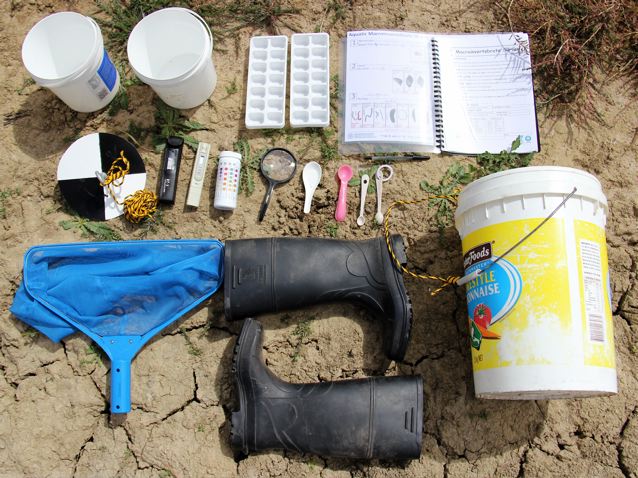
The DIY water testing kit, including big buckets, little buckets, ice-cube trays, teaspoons, magnifying glass, pH strips, homemade Secchi disk, EC meter, pool net, boots, ID charts and recording sheets. If you have a toddler in attendance, you may consider a change of clothes for yourself and toddler.

Inspired by permaculture’s commitment to observation, over the last couple of years, we’ve become enthusiastic/compulsive gatherers of data about our farm. Everything we can think of to measure, we’ve tried to measure. Now, as we scale up our interventions, we can begin to track our impact and refine our management accordingly. As part of this, we’ve started a seasonal water quality testing program to monitor changes in the quality of our catchment as we revegetate the catchment and manage grazing more intensively.

We’ve assembled our own water testing kit, all stored conveniently in a secondhand mayo bucket from the local chip shop. Using this, there are a few characteristics we’ll test seasonally:

  • salinity and temperature (both tested using an EC (Electrical Conductivity) Meter from your friendly local hydroponics vendor),
  • pH (tested using pool pH strips from the hardware shop),
  • turbidity is a measure of the amount of solids suspended in the water (measured with a DIY Secchi disk or turbidity tube),
  • macroinvertebrate populations, the presence and composition of which is also an indicator of pollution levels (gathered with buckets and nets, and sorted with teaspoons into ice-cube trays).

Continue reading →

Visions of the Past: historical photos of Anacotilla

15 Thursday Jan 2015

Posted by Joel in history

≈ Leave a comment

Tags

Anacotilla, farm, history, photography, seasons, southwestern Fleurieu, trees, waterways, winter

4567. Anacotilla Bridge

Anacotilla Bridge on Main South Road, with Lorna Kelly (riding side saddle), E.C. and G.F. Kelly (c1896). Image courtesy of the Yankalilla & District Historical Society.

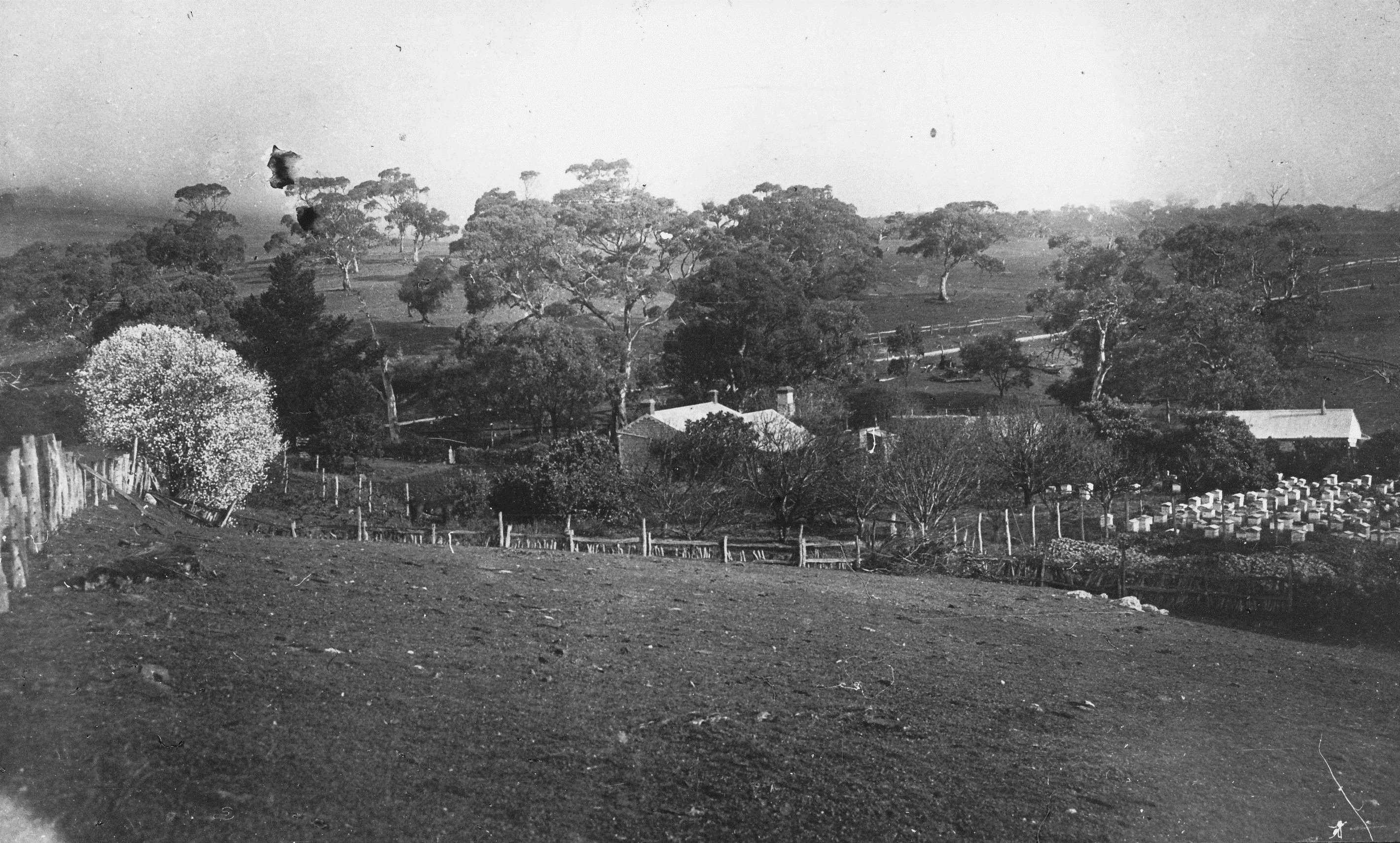
Our farm, Yarnauwi, is one lot of the once expansive Anacotilla pastoral property. Just over the ridge, in the Anacotilla river valley, are the old workers’ cottages, and on the hillside opposite, the sprawling homestead and outbuildings. We’ve recently been corresponding with the Yankalilla and District Historical Society about our interest in the property’s history, and they shared with us a number of photographs from the late 1800s onwards.

4563. Anacotilla

“Anacotilla”, Second Valley, home of A.C. Kelly in the 1880s. Image courtesy of the Yankalilla & District Historical Society.

IMG_5348

The Anacotilla cottage and outbuildings, 2014, viewed from Main South Road, near Paradise Drive. While the cottage has undergone substantial additions and renovations, the original two-room dwelling still exists at its centre.

Continue reading →

Regeneration: Two years of practising patience

16 Sunday Nov 2014

Posted by Joel in ecology, planning, regeneration, trees, waterways

≈ 4 Comments

Tags

before and after, ecology, erosion, farm, fencing, kangaroos, permaculture, planning, propagation, revegetation, seasons, southwestern Fleurieu, trees, waste, waterways

IMG_5332

Some might consider Shark-mesh overkill for allowing rushes to regenerate.

In our first year of working on the farm, we really tried to practise the permaculture principle of long and thoughtful observation, but it always competed with our own impatience to see change. In that first flurry of clearing gullies and planting seedlings, I remember trawling the internet for before-and-after shots of other people’s reveg projects: something to help imagine a future for the block. Seasoned tree-planters told us we’d see real change in five years, the optimistic suggested three, others, fifteen.

PycnanthaRegen

Self-regenerating golden wattle (Acacia pycnantha) after two years, and protection from kangaroos. This wattle was one of four trees present on the entire property in 2012.

Now at the two year mark, we are noticing change. Removing cattle and fencing sensitive areas has allowed a fuzz of groundcover to begin growing over the barest of gullies. Fences have reoriented deer and kangaroo movement and grazing patterns. Some seedlings planted in the cold, soggy winter of 2013 appeared to die, but then surprised us by resprouting and growing at a cracking pace the following autumn. Other plants that were repeatedly pruned back to their tree-guard height by roos have invested their growing energy into roots and woody stems.

Continue reading →

← Older posts
Newer posts →

Yarnauwi on Etsy

Enter your email address to follow this blog and receive notifications of new posts by email.

Join 223 other subscribers

What We’re Writing About

alpacas annual report art art and craft bees before and after birds books building cheese climate change craft damara design downloads ecology embroidery erosion etsy events farm fencing fire Fleurieu Fleurieu Coast Fleurieu Peninsula food fungi future hack hiking history illustration insects kangaroos leather leathercraft linoprint livestock logo nursery permaculture photography picnics planning plants Plastic-free July printing propagation rain recycling regeneration regenerative agriculture reuse revegetation sea seasons seeds shed sheep sheepskins shop soil southwestern Fleurieu stiles summer textiles tractor trees ute waste water waterways winter zones

Meta

  • Create account
  • Log in
  • Entries feed
  • Comments feed
  • WordPress.com

Blog at WordPress.com.

  • Subscribe Subscribed
    • Yarnauwi Farm
    • Join 223 other subscribers
    • Already have a WordPress.com account? Log in now.
    • Yarnauwi Farm
    • Subscribe Subscribed
    • Sign up
    • Log in
    • Report this content
    • View site in Reader
    • Manage subscriptions
    • Collapse this bar
 

Loading Comments...