A break in the season

Tags

, , , , , , , , ,

IMG_6090

The rain gauge almost full!

With the big rains of the last couple of weeks, it feels like we’re approaching an break in the seasons. In most parts of the property, the cracks that open in the clay over summer are softening and closing, and there’s a green fuzz of new growth on the ground (especially in the areas with existing, dry ground cover, we’ve noticed). The sheep march briskly between discoveries of fresh grass and happily fan out over new paddocks.

IMG_6093

A self-sown red gum pushes through the cracks.

Continue reading

The Salvage Season

Tags

, , , , , , , ,

IMG_5900_2

The steely gaze of a doll, complete with an electrical tape necklace.

With the chilling of the air, it’s time for us to don our gloves and get stuck into mining the junk that lines the banks and bed of our erosion gullies. It’s become an annual tradition to pick a path through chest-high phalaris, filling bags with debris. It’s scratchy, dusty work, with plastic milk bottles and the remains of plastic bags collapsing into confetti with the gentlest of touches. Yet despite the discomfort, we can’t help but have a forensic fascination with what we unearth. Each discovery is a cryptic clue into the lives of our predecessors, those who decided that the headwaters of a creek would be the best place for their unwanted bric-a-brac.

IMG_5889

A broken clock amid bones. We’ll leave you to come up with your own metaphors.

Continue reading

The Whole Beast: harvesting hides

Tags

, , , , ,

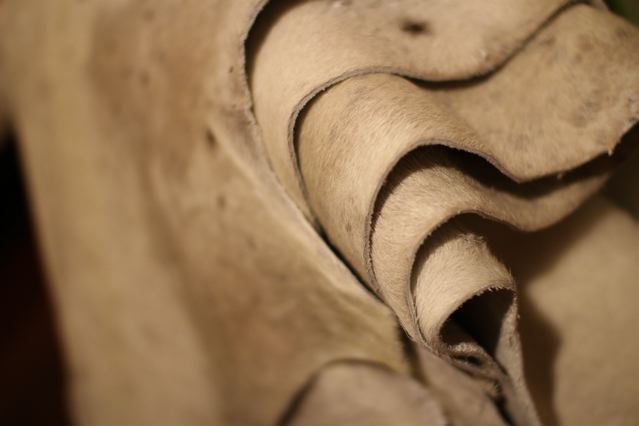
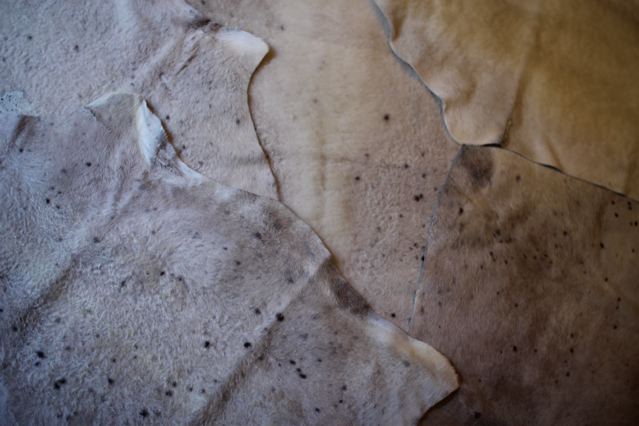
IMG_5994When we took our sheep to be slaughtered towards the end of last year, in the spirit of using the whole beast, we asked the meatworks if we could keep the skins. Wiltshire Horns are not renowned for their hides, and while the abattoir workers looked at us a little askance, they played along. As soon as the animals were killed, we drove the skins across to Port Elliot, where tanner Tony Scott salted them and enthusiastically took us on a tour of his tannery, one of the few surviving such establishments in Australia.

IMG_5989

This week a package arrived from Port Elliot. Inside were the skins, transformed from their dusty, paddock hue: the lamb skins soft and creamy, the elder beasts a light, dappled grey with black spots. While there’s no doubt that draping one’s home in animal hides brings with it a whiff of hillbilly, it’s also deeply satisfying to use as much as we can of our animals.

IMG_5988

As an experimental run, most of these skins are already accounted for, but if you would like first pick on future hide harvests, let us know.

Ram update: The Pecorino Support Group

Tags

, , , ,

IMG_5784

Pecorino, with new BFF Ernesto the Alpaca

A few weeks ago, Pecorino, our new Damara-Dorper cross ram arrived at the farm. Initially, he seemed a little coy, intimidated by all from the alpacas to last year’s lambs. Within even a week, it was clear that he was becoming enculturated into the flock, following their cues to move to new pasture, and joining the usual welcoming committee whenever we come to visit.

IMG_5788

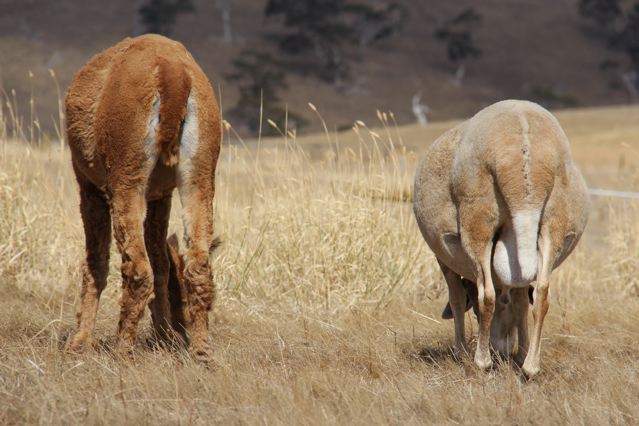
Friendship is parallel grazing. Note Pecorino’s fat-tail, a Damara characteristic, it’s the camel’s hump of the sheep world.

Now, Pecorino’s assembled something of a support group around himself, composed of alpacas Fidel and Ernesto and a wether lamb. They tend to remain aloof of the rest of the flock, grazing a little away from the rest. While other sheep-farming pals tell us that this is not uncommon, we’re genuinely amazed to see how Pecorino’s robust desert breeding is exhibited in his grazing habits. Where the Wiltshire Horns hurry for shelter at the first glimmer of sunlight and sit panting until a cloud covers the sun again, Pecorino and his clique munch on, apparently regardless of temperature, and far less selectively than the others. Now all we need is for him to start sharing those genes around.

IMG_5782

Pecorino joins the party.

Maintain the rain! Piecing together the past to imagine a future

Tags

, , , , , , , , , , , , , , , ,

It’s been a dry year on the Fleurieu Peninsula. After the inundation of 2013, 2014’s rainfall came in almost 200mm shy of the year before, and about 100mm short of the average. By February 2015, the dam had receded to a few centimetres of sludge, and the water carter had come to top up the stock water tanks. While there’s no doubt that the Fleurieu Peninsula has had the Mediterranean pattern of dry summers and cool, wet winters for some time, recently I’ve begun to wonder whether this pattern has shifted towards greater aridity as successive land-uses have cleared the landscape.

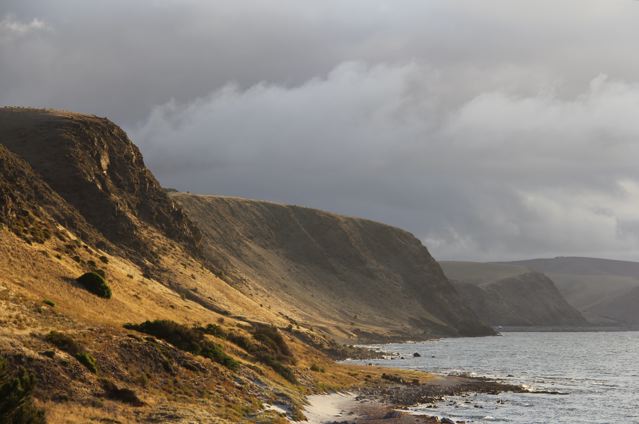
Curruckalinga, looking over St. Vincent’s Gulf, 1846, George French Angas, depicting a mosaic of woodland and open grassland. From the description: “This view is taken from the rocky hills near Mr Kemmis’s Station, to the northward of Rapid Bay … The undulating appearance of the country here represented, together with the singular manner in which the trees are dotted about in all directions over the landscape … principally ‘casuarinae’ or she-oak, with ‘eucalyptus’.” From the collection of the State Library of South Australia, B15276/33.

At the time of European colonisation, the Fleurieu Peninsula was most likely covered with a mosaic of woodland, forest and grasslands, maintained through Aboriginal burning and land management practices. In his paper on the discovery and settlement of the Fleurieu (1986), Rob Linn draws from the diaries of settlers in his descriptions of the landscape of the South Western Fleurieu. Writing in 1838, William Giles described the landscape around Rapid Bay, as “a most beautiful valley, the soil of great depth covered with most luxuriant herbage … on the sides of these hills we found plenty of keep for sheep, and wherever the grass had been burnt in these places it was looking beautifully verdant … fine land, excellent water, plenty of timber …” This was echoed by John Stephens in 1839, describing the “country from Cape Jervis upwards” as “very picturesque” and “well-timbered” (Linn 1986). Continue reading

Year of the Sheep: Introducing Pecorino

Tags

, , , , , , ,

IMG_5770

Despite his noble bearing, thus far Pecorino has demonstrated a rather sheepish personality.

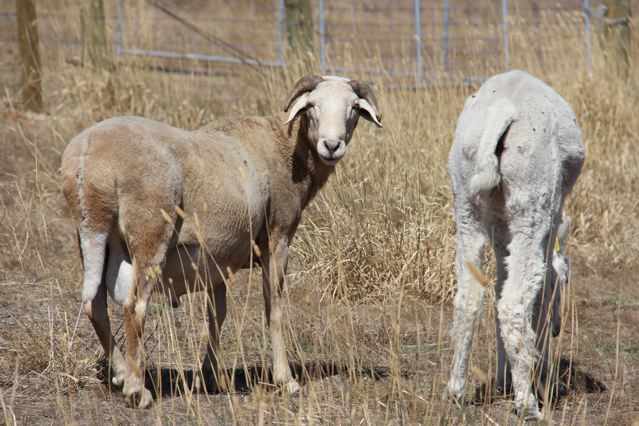
With the Year of the Sheep just around the corner on the Chinese calendar, it’s fitting that we’re celebrating the arrival of Pecorino. Pecorino is a Dorper-Damara cross ram, adopted from our friends Stefan and Amanda from their property at Inman Valley. Although our Wiltshire Horn-Dorper lambs have been pretty unfazed by the blinding summer heat, their Wiltshire Horn mothers have not fared so well. Enter Pecorino and his robust African desert-survival genetics and fat-tailed energy-storing mystique. Continue reading

Farm hack: reusing livestock water

Tags

, , , , , , , , ,

IMG_5738

The new Trough Hose Outlet Mark 2 (aka. THOM2), in position.

When our livestock are moved into the next paddock, or the trough needs a clean, the contents, up to 450 litres of water, are dumped into the pasture. While we’ve tended to hold a ‘survival-of-the-fittest’ mentality for our tree planting, we couldn’t help but feel that this water could be better directed on nearby seedlings. So, a little while ago, we whipped up our first attempt at a stock trough water diverter that would do just this.  Continue reading

Testing water quality

Tags

, , , , , , , , ,

IMG_5573

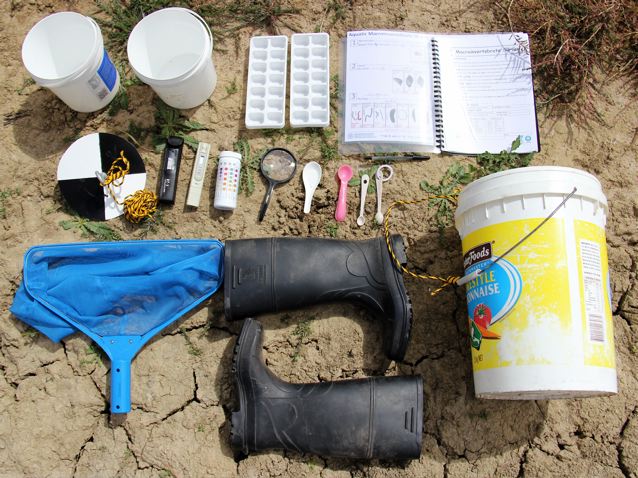
The DIY water testing kit, including big buckets, little buckets, ice-cube trays, teaspoons, magnifying glass, pH strips, homemade Secchi disk, EC meter, pool net, boots, ID charts and recording sheets. If you have a toddler in attendance, you may consider a change of clothes for yourself and toddler.

Inspired by permaculture’s commitment to observation, over the last couple of years, we’ve become enthusiastic/compulsive gatherers of data about our farm. Everything we can think of to measure, we’ve tried to measure. Now, as we scale up our interventions, we can begin to track our impact and refine our management accordingly. As part of this, we’ve started a seasonal water quality testing program to monitor changes in the quality of our catchment as we revegetate the catchment and manage grazing more intensively.

We’ve assembled our own water testing kit, all stored conveniently in a secondhand mayo bucket from the local chip shop. Using this, there are a few characteristics we’ll test seasonally:

  • salinity and temperature (both tested using an EC (Electrical Conductivity) Meter from your friendly local hydroponics vendor),
  • pH (tested using pool pH strips from the hardware shop),
  • turbidity is a measure of the amount of solids suspended in the water (measured with a DIY Secchi disk or turbidity tube),
  • macroinvertebrate populations, the presence and composition of which is also an indicator of pollution levels (gathered with buckets and nets, and sorted with teaspoons into ice-cube trays).

Continue reading