Book Review: Growing a sustainable farm with ‘Farms with a Future’

Tags

, ,

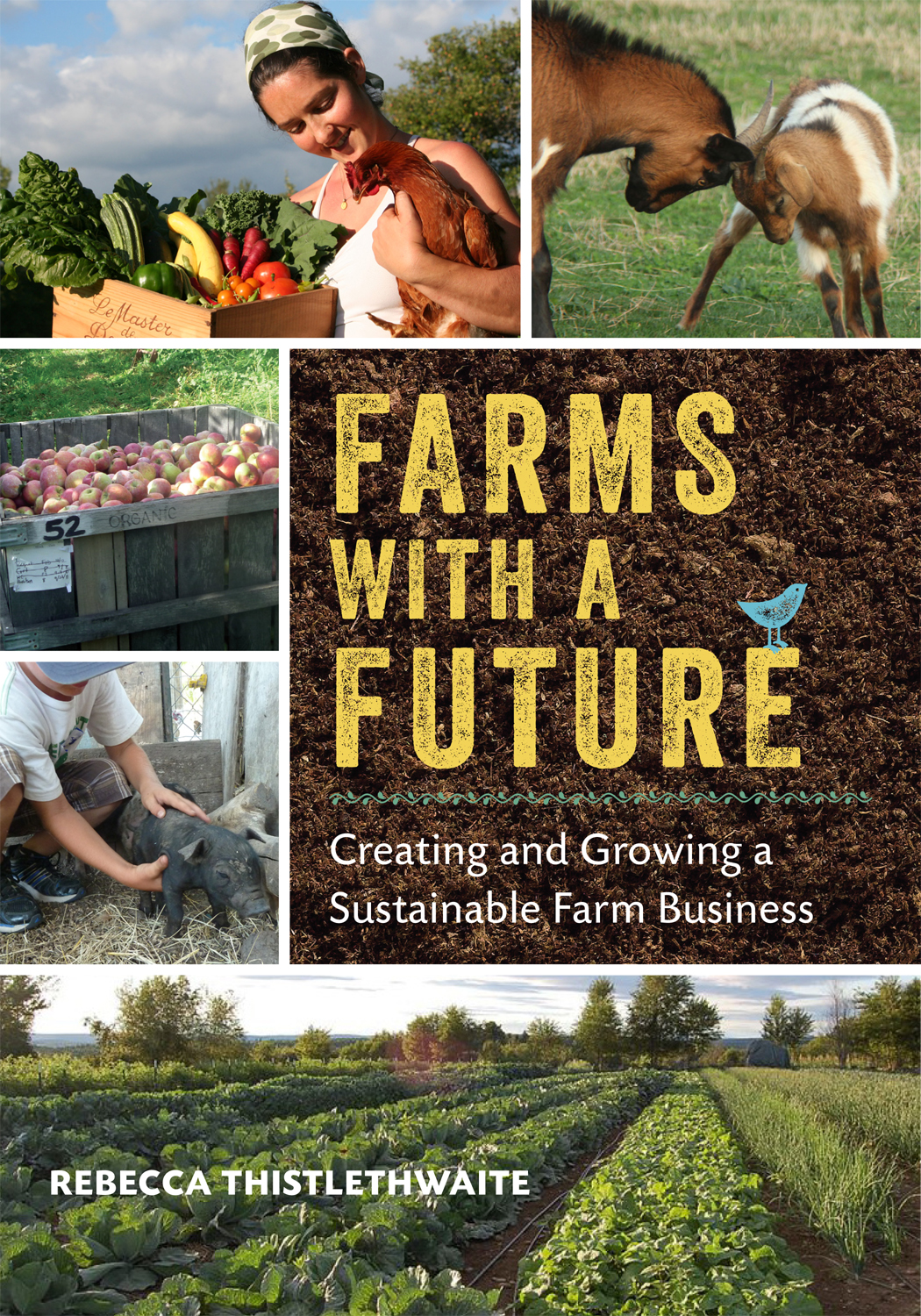
In her book Farms with a Future (Chelsea Green, 2012), American small farm consultant, sometime-homesteader and former family rancher Rebecca Thistlethwaite offers a brisk, yet detailed, guide to building and running a sustainable farm business. Writing on a range of essential topics including marketing, land access, finance and business planning, equipment, soil and water management, record-keeping and human resources her writing is concise and targeted, supported by her own experiences together with a selection of excellent case studies describing how the principles outlined are expressed in the real world. Each chapter offers a discussion of key issues and strategies for sustainable farms, a case study and summary of short, sharp “Take Home Messages” drawn from the text. While it is necessarily written for a North American audience, and some US-focussed sections on regulation or financing can be skipped over, there is still much here to inspire Australian readers. Continue reading
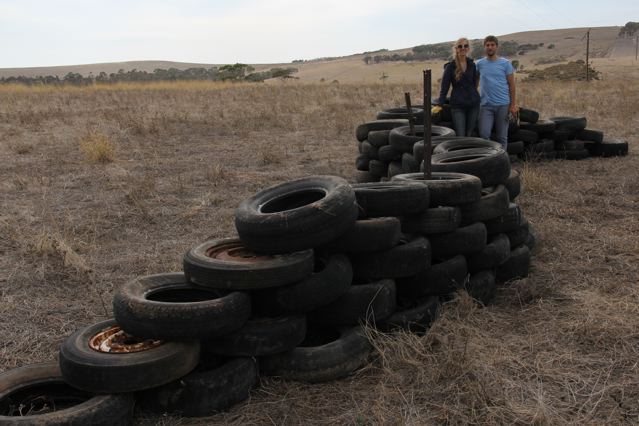
Uses for tyres: livestock shelters

Tags

, , , , , , , ,

IMG_3345

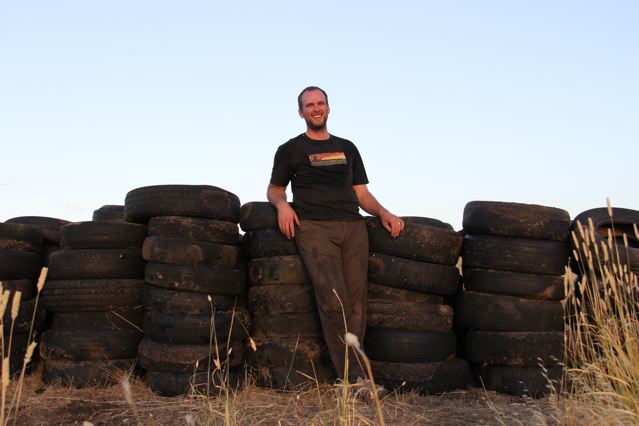
Pete, lifter of heavy things, Employee of the Month

Earlier in the year, our friend Pete decided that the time was right to haul the last clump of tyres from Zephyr Creek. It was about 8 o’clock at night, and after a cursory glance, he predicted that there “couldn’t be more than 30 or 40 in there.” Almost 200 tyres later, Pete had earnt his “Employee of the Month” status, and with assistance from Will, had built a respectable tyre mound on the edge of the creek. Thanks. I think.

IMG_3965

The elegant, sinuous form of a tyre sheep shelter, modelled by tyrechitects Abi and Shane.

The patch buried under tyres is slated for revegetation this winter, so we couldn’t leave the tyres there indefinitely, nor could we afford their disposal fees, nor could we find any earthship or go-kart track builders interested in taking them off our hands. So after pondering them for a while, we settled on Option E: using them to construct sheep shelters. Continue reading

If a tree falls…

Tags

, , , , , ,

IMG_3799A couple of months after the central third of our biggest remnant red gum crashed to earth, I climbed into the centre of the fallen limbs to try to remove some timber for erosion control structures. I was surrounded by the faint, constant pattering of distant rain. The tree was rustling, but no wind moved the leaves. I put my ear to the boughs and realised the sound was coming from inside, exhaling as the timber dried and cracks slowly opened in the bark. Meanwhile, in the leaf litter below, the spiders and beetles delight in the thick undergrowth of their new canopy. Continue reading

Erosion control: 15 months on

Tags

, , , , , , , , ,

One of the first interventions we made on the property was trying out some very rough erosion control on this scoured patch on our boundary. Earthworks from recent fencing had disturbed the soil and invited headcuts to form. With help from Pete and Freya, we tentatively set up a couple of lo-fi erosion strategies, informed by the work of Watershed Artisans (formerly Dryland Solutions) and Brad Lancaster, both of whom we’ve gushed about before. We reshaped the main headcut to soften the overflow, and positioned some kind of mutant One Rock Dam/Zuni Bowl at an intersection between two small headcuts – not something I’d do again. We also positioned a One Rock Dam on contour above the entire area in an effort to slow and disperse water flow.

IMG_1970

A scoured, erosive patch, December 2012.

Continue reading

Pipe Dreams: How to set up a watering system for stock

Tags

, , , , , , , ,

‘Pipe Dream’: useful for passing time in the late 1980s, not that useful for planning livestock systems.

One of our key milestones in the development of the property this year was the establishment of a watering system for livestock. Having a watering system supports our fencing of the farm dam and waterways for habitat regeneration and also allows us to more intensively manage the movement and impact of livestock through rotational grazing. While we’re still the furthest thing from expert, with the advice and support of our neighbours, we managed to knock together a watering system that works. In researching and developing our own plans, we found an absence of basic information on setting up stock systems, so the ideas below are a few of the things we learnt or found useful in planning a system for our own context and landscape. They are just one perspective in informing your own planning, and shouldn’t be read as an endorsement of any particular way of doing things.

Continue reading

New artwork: painting summer

Tags

, , , ,

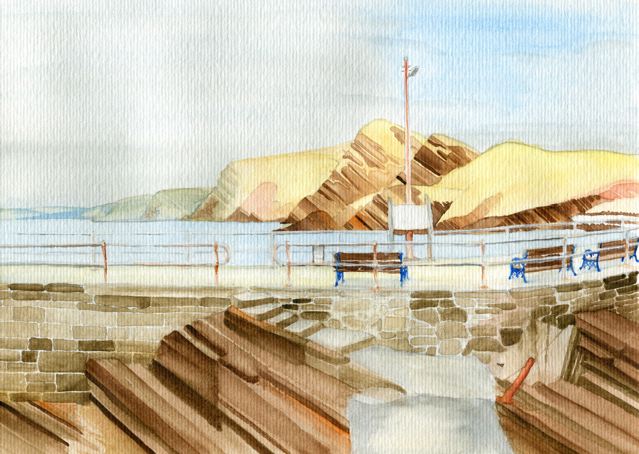
img010_2

Second Valley causeway, looking towards Normanville.

A little while ago, it occurred to me that maybe I should give watercolour a crack. The theory was that I’d be able to work fast enough to bang out a painting during toddler naps. In reality, I’ve still only finished a handful of works over the last six months, and as a consequence my skill development has been glacial. That said, it’s still a pleasure to sit down with the brushes and attempt to wrangle the Czech-made watercolour set into South Australia’s less exuberant colour palette.

Continue reading

A One-Page Place Assessment for TBC Farm, Second Valley

Tags

, , , , , , , , , , ,

Brad Lancaster’s books on Rainwater Harvesting would have to be among the most consistently inspiring books we own. Two volumes into his trilogy on Rainwater Harvesting for Drylands and Beyond, Lancaster combines accumulated community wisdom with permaculture principles to produce lavishly illustrated, practical and highly accessible manuals for managing water in urban and rural environments. Consistent with permaculture thinking, Lancaster urges land managers to spend time observing the season patterns of the landscape to more effectively design for sustainable, integrated water management. One method of doing this is to compile a One Page Place Assessment, drawing together essential climatic and ecological information about your particular location.

Our first year has been one of spreadsheets, mapping out our seasonal observations and activities, and the One Page Place Assessment concept is a elegant way of compiling climatic data from Second Valley and the surrounding area. We’ve finally completed the first version of a place assessment for our property, with much of the data drawn from Bureau of Meteorology stations nearby (Myponga Reservoir being the furthest). While we have tailored information to our particular location, we hope it will be of use to other landowners in the region. We have also referenced information sources so others can draw on the same resources in exploring their own area.

You can download our One Page Place Assessment here. Continue reading

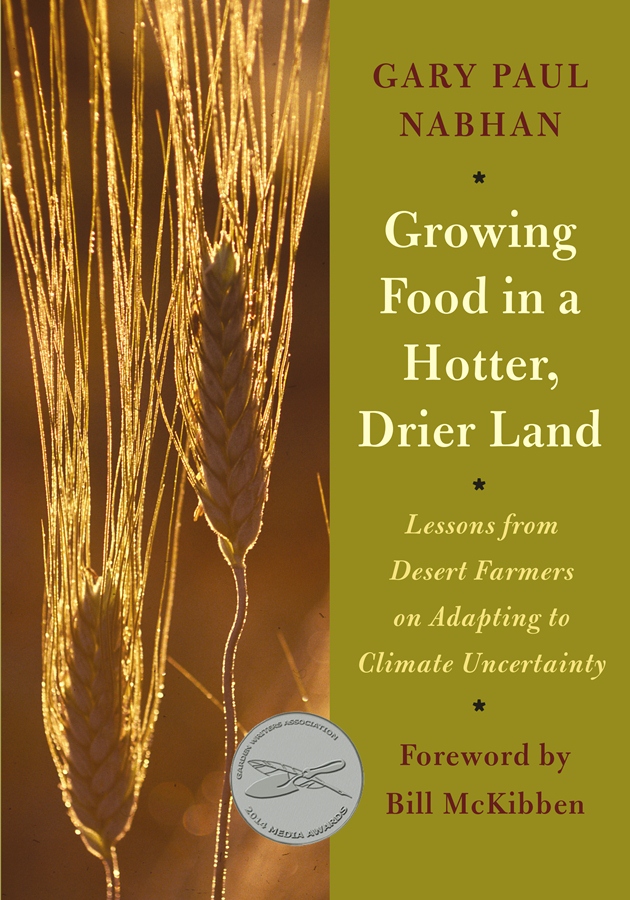
Book Review: Embracing an arid future in “Growing Food in a Hotter, Drier Land”

Tags

, , , , , , , , , , ,

Years before there was talk of locavores and 100-mile-diets and omnivore’s dilemmas, I came upon Gary Nabhan’s book Coming Home to Eat, a personal account of his experiences striving to solely eat food produced in his home bioregion of the US-Mexican borderlands in southern Arizona. His observations as renowned desert ecologist and ethno-botanist redefined how I thought about food and sustainability and accompanied me on my own sustainable food explorations for years after.
I get the feeling that his latest book, Growing Food in a Hotter, Drier Land: Lessons from Desert Farmers on Adapting to Climate Uncertainty (Chelsea Green, 2013), may be another companion for us in our adventures on the farm. While Growing Food is as practical as its title suggests, it is permeated by Nabhan’s respect for the insights of cultures deeply connected to the land, and his belief that communities connected to their bioregion are the most resilient in the face of environmental change. Continue reading

Travels in Inter-Tussock Space: Planning for Woodland

Tags

, , , , , , , , , , , ,

We’ve seeded our last 150 tubes in preparation for planting in a few months time. When the rains come, we’ll have over 1000 plants ready to go. Most are destined for the regeneration areas we’ve fenced around the waterways, but a few others are non-indigenous livestock fodder plants, timber trees and food plants we’ve raised from seed and cuttings to begin developing other zones around the farm.

IMG_3579

It’s a Pink Gum Woodland, it just doesn’t know it yet.

Late in 2013, along with a posy of other plant nerds, we attended a workshop with botanist Ann Prescott (author of It’s Blue with Five Petals) to explore ideas behind revegetation for habitat. We walked through remnant woodland in the hills above Yankalilla, and tried to imagine how our farm might have looked 180 years ago. Continue reading