
Tags
design, ecology, farm, permaculture, planning, seasons, southwestern Fleurieu, summer, water, waterways
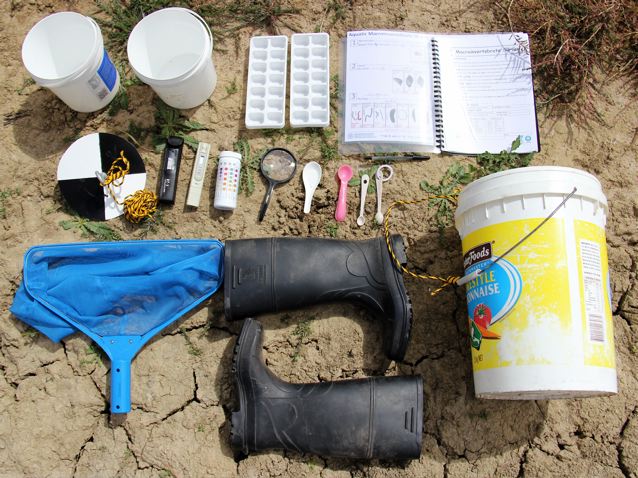
The DIY water testing kit, including big buckets, little buckets, ice-cube trays, teaspoons, magnifying glass, pH strips, homemade Secchi disk, EC meter, pool net, boots, ID charts and recording sheets. If you have a toddler in attendance, you may consider a change of clothes for yourself and toddler.
Inspired by permaculture’s commitment to observation, over the last couple of years, we’ve become enthusiastic/compulsive gatherers of data about our farm. Everything we can think of to measure, we’ve tried to measure. Now, as we scale up our interventions, we can begin to track our impact and refine our management accordingly. As part of this, we’ve started a seasonal water quality testing program to monitor changes in the quality of our catchment as we revegetate the catchment and manage grazing more intensively.
We’ve assembled our own water testing kit, all stored conveniently in a secondhand mayo bucket from the local chip shop. Using this, there are a few characteristics we’ll test seasonally:
- salinity and temperature (both tested using an EC (Electrical Conductivity) Meter from your friendly local hydroponics vendor),
- pH (tested using pool pH strips from the hardware shop),
- turbidity is a measure of the amount of solids suspended in the water (measured with a DIY Secchi disk or turbidity tube),
- macroinvertebrate populations, the presence and composition of which is also an indicator of pollution levels (gathered with buckets and nets, and sorted with teaspoons into ice-cube trays).







 Yarnauwi Farm