• About
  • Anacotilla: History & Hearsay
  • Junk: A Curated Collection
  • Resources
  • Species List
  • Yarnauwingga and beyond

Yarnauwi Farm

~ Fleurieu Peninsula, South Australia

Yarnauwi Farm

Tag Archives: ecology

Deep Winter comes to the Fleurieu!

16 Tuesday Jul 2019

Posted by Joel in events, food, livestock, regeneration

≈ 4 Comments

Tags

agrarian, conference, deep winter, ecology, farm, farming, Fleurieu, Fleurieu Coast, food, gathering, livestock, permaculture, regenerative agriculture, soil, winter

Joel dusted off his design degree to contribute a logo to the gathering.

Each winter since 2015, aspiring and established small-scale and regenerative farmers and their supporters and allies have gathered somewhere in Australia as part of the Deep Winter Agrarian Gathering to share ideas and inspiration for their projects and enterprises. In June 2019, this convergence drifted westwards to be held in Willunga, South Australia, and we were delighted to participate.

150 aspiring and established regenerative farmers, growers and their friends gathered in Willunga, SA, for the Deep Winter Agrarian Gathering.

The tone for the convergence was set with a keynote from former CSIRO microbiologist and climate scientist Walter Jehne, who spoke on the role and responsibility of rebuilding soil carbon and water cycles through agriculture and land management. Through his inspiring presentation, Jehne drew on indigenous land management as described in the work of Bill Gammage and Bruce Pascoe to also establish a precedent for the capacity of Australian soils to hold significant amounts of carbon and water.

Walter Jehne, in full flight.

Continue reading →

Yarnauwi Treefest 2019

10 Monday Jun 2019

Posted by Joel in diy, ecology, regeneration, trees, waterways

≈ 8 Comments

Tags

design, ecology, erosion, events, farm, Fleurieu, Fleurieu Coast, nursery, permaculture, propagation, revegetation, seasons, soil, trees, water, waterways, winter

A serial tree-planter manages to synchronise his outfit with the colouring of Eucalyptus occidentalis.

A couple of days before this year’s tree planting, I rang our friend and regular tree-planter Jeremy, and told him that three out of four family members were sick with the flu and we were thinking of cancelling this year’s planting weekend. He didn’t accept that proposal, effectively telling us that tree planting would happen regardless of our involvement, that between his family and another they would take care of catering, rally the volunteers and get the trees in the ground.

It has always been an aspiration of ours that the farm might offer a place for people to be able to develop connection with the landscape through collaboration on land-based projects – “where people and the landscape can restore each other”. I hope that Jeremy’s response, and the support of our friends and community over the last seven years of tree-planting is an indication of this aspiration in development. In this spirit, this year we were also delighted to host regenerative side projects such as Steven Hoepfner’s seed ball regeneration experiment, and provide a waterway for Sue and David Speck’s sedges, and a forever home for Greg Wood’s trees.
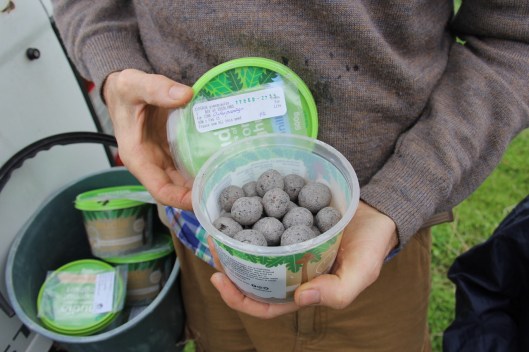
Steven’s seed ball project: local provenance bundles of seed and nutrients distributed across revegetation zones to germinate when the conditions are right.
Continue reading →

Nightlife in the Country

08 Saturday Jun 2019

Posted by Joel in art & craft, ecology, exploring

≈ 4 Comments

Tags

camera, ecology, farm, Fleurieu, Fleurieu Coast, fox, kangaroos, photography, seasons, southwestern Fleurieu, trees, wildlife

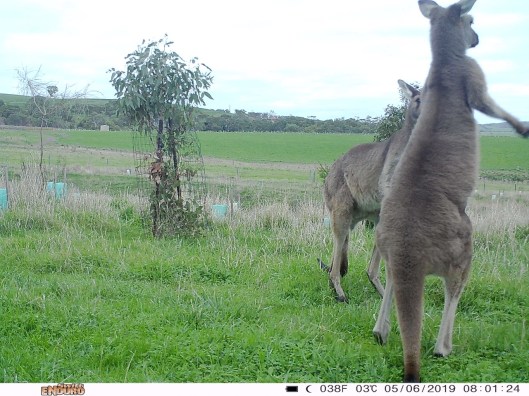
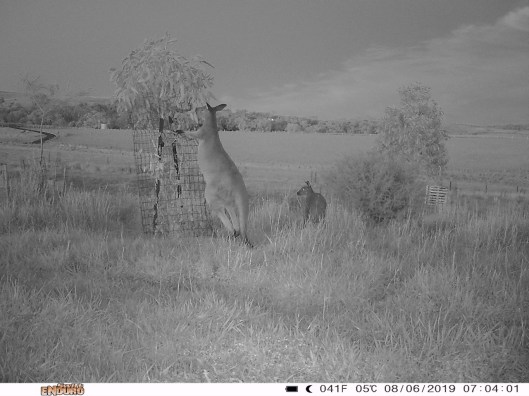
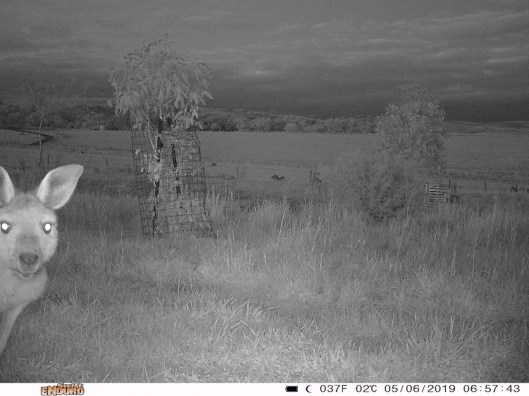
A little while ago I received a motion camera, triggered by movement and able to shoot in complete darkness with an infra-red flash. I mounted it on a fence post, scattered some food scraps in front and left it for a week. Over the week it’s offered us a fascinating window into the life of the farm.

Curious kangaroo

Boxing match

The fight gets out of hand

Persistence is rewarded

Very curious kangaroo.

Unsurprisingly, the hordes of kangaroos feature heavily. They graze through the day and night, occasionally box, and one problem-solver has multiple attempts at reaching  the enticing leaves of a mesh-guarded sapling. Continue reading →

Not ‘if’, but ‘when’: planning for fire

07 Monday Jan 2019

Posted by Joel in ecology, planning, regeneration, trees

≈ 5 Comments

Tags

bushfire, climate change, design, ecology, erosion, farm, fire, Fleurieu, Fleurieu Coast, permaculture, planning, resilience, revegetation, seasons, soil, summer, trees, zones

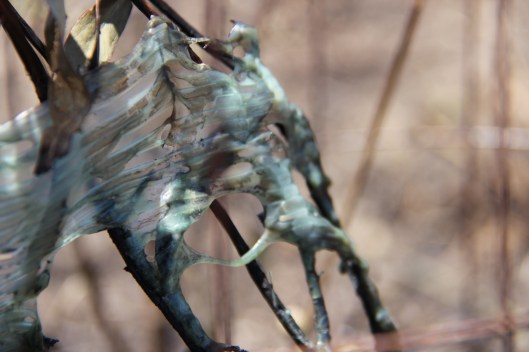
Melted tree guard on a eucalyptus seedling.

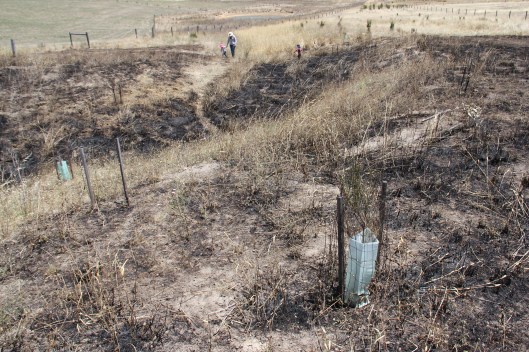
A few evenings ago, someone set off fireworks on the road beside our property. Embers from the fireworks landed in the grass on the property boundary and quickly took, spreading through the dry summer grass along the fence and down a drainage line. Thankfully, our neighbours quickly noticed and set to work with their own fire unit while awaiting the arrival of the police and Country Fire Service. The blaze was contained with minimal damage, but it’s stimulated us to revisit our property plans and consider how we’re designing for the inevitability of fire.

Scorched earth and singed trees.

Continue reading →

Farming fungi

11 Saturday Aug 2018

Posted by Joel in ecology, exploring, regeneration

≈ 3 Comments

Tags

ecology, farm, Fleurieu, Fleurieu Coast, fungi, mycorrhiza, photography, revegetation, seasons, soil, southwestern Fleurieu, trees, winter

Getting excited about fungi on a wet day at Hindmarsh Falls, Fleurieu Peninsula.

In the last year or so we’ve really begun to appreciate the importance of fungi in a living landscape. The fungi (toadstools, mushrooms and so on) we see pop up after rain are the fruiting bodies of sometimes vast underground fungal networks. Some of these fungi form relationships with plant roots that are often mutually beneficial and enhance the plant’s ability to access nutrients and moisture. The Australian National Botanic Gardens suggest that some 80-90% of Australian plants form or benefit from mycorrhizal networks (fungal associations), and may derive up to 30% of their food through this symbiotic relationship. Continue reading →

Making a floating habitat island

12 Thursday Jul 2018

Posted by Joel in ecology, propagation, regeneration, waterways

≈ 2 Comments

Tags

birds, dam, design, ecology, habitat, how to, island, making, revegetation, water, waterways

DCIM100GOPRO

The planted habitat island, ready to launch

Regular readers and supporters of our farm will be familiar with the challenges we’ve faced trying to re-establish native vegetation in the face of large populations of rampaging herbivores. Inspired by an idea from @nature_at_work_ (check them out on Instagram) and folks around the world working to increase urban and rural habitat, we thought we’d construct a floating habitat island.

Once installed in the dam, we hoped the island would function as a seed bank for aquatic plants, a fox-proof roost for waterbirds, and offer filtration through the plant roots as well as aquatic shelter and habitat.

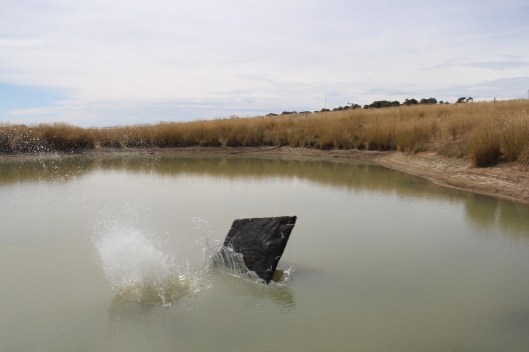
During the summer, our friend Shani, assisted by a team of kids, got to work assembling a frame from some leftover PVC stormwater pipe to act as the float, with a length of shade cloth salvaged from our gully junk to act as a base onto which we could later plant local aquatic plants. The frame was tied to a rock anchor and then launched with great ceremony.

IMG_9909

The official launch of the habitat island (and anchor)

IMG_9910

Installation requires a great deal of precision and technical know-how.

In the following months, the island became popular with waterbirds of all types, with ducks often spotted perched on the floating edge, grebes diving underneath and the enclosed centre of the island becoming coated with feathers and bird manure. Continue reading →

The Occasional Farmers’ Book club: Discovering Aldo Leopold

01 Sunday Jul 2018

Posted by Joel in books, ecology, history

≈ Leave a comment

Tags

Aldo Leopold, books, ecology, history

51UByRehjhL._SX302_BO1,204,203,200_

I’d never read the work of Aldo Leopold, but always had a vibe that philosophically we might have something in common. He’s one of the most prominent voices from the early North American conservation movement and I’d read of him regularly and particularly of the “Land Ethic” he articulated. I finally tracked down a copy of one of his influential works A Sand County Almanac, bundled with some essays from Round River, and published posthumously in 1949. I have a friend who once became enraged by how Thoreau’s work seemed to primarily be read in pull-quote form on social media or on email footers, and Leopold too is eminently quotable. In that spirit, this article will really be a collection of salient quotes tenuously connected with our own experience.

Country
About three fifths of my volume of A Sand County Almanac is dedicated to Leopold’s observations of his Wisconsin home, together with sections reflecting on other landscapes of North America. While his meditations on geese landing on ponds and the accumulated wisdom of pine trees are a beautiful thing, I admit I skipped over some of this section to get to his more directly philosophical work. One of his central arguments is about the need to separate economic perceptions of value from our appreciation of the landscape, with a particular focus on acknowledging the social and cultural importance of a landscape and the intrinsic worth of ecological diversity and resilience. From his essay Country,

There is much confusion between land and country. Land is the place where corn, gullies and mortgages grow. Country is the personality of land, the collective harmony of its soil, life, and weather. … Poor land may be rich country, and vice versa. Only economists mistake physical opulence for riches. Country may be rich despite a conspicuous poverty of physical endowment, and its quality may not be apparent at first glance, nor at all times. … In country, as in people, a plain exterior often conceals hidden riches, to perceive which requires much living in and with.

For me this echoes the tension we’re trying to navigate with Yarnauwi, to transition the landscape away from one that has grown gullies and mortgages for generations to one that again supports a diversity and complexity of lives, and that acknowledges and inhabits the many cultural stories that have shaped it. If we think about the permaculture principle of “obtaining a yield”, Leopold suggests that the yield may not be economic or even tangible, but can still be something of value. Continue reading →

Yarnauwi: the First Five Years

07 Sunday Jan 2018

Posted by Joel in art & craft, diy, ecology, events, history, regeneration, trees, waterways

≈ Leave a comment

Tags

art, books, design, ecology, history, illustration, photography, planning

IMG_9876
Towards the end of 2012 we first came to Yarnauwi Farm. The property at that time was a single paddock, carved up with junk-filled erosion gullies and with two regal, remnant red gums smeared up the hillside by the wind. However, set within a grand landscape of rolling hills and a couple of kilometres from the coast, there was something about it that captured our attention and our aspirations.

Five years later, the property is beginning to change. The survivors of annual tree planting are now heading skywards, most of the junk is gone, paddocks have been fenced, some erosion gullies are stabilising, sheep graze, fruit trees peek from the tops of tree guards and rain thunders on a shed roof. The last five years have brought with them an almost vertical learning curve, challenge, plenty of failures and the indescribable satisfaction of seeing seedlings become trees become woodland.

We’ve tried documenting this process online here at yarnauwi.com, but to celebrate this milestone we’ve also produced a limited edition book curating photos, illustrations and writings from the last five years.

This slideshow requires JavaScript.

Yarnauwi: The First Five Years is divided into sections on the history of the property, trees and tree planting, creek restoration and erosion management, treasures extracted from the junk heaps, property planning, “obtaining a yield” and landscape change through the Fleurieu seasons. Each section is copiously illustrated with photographs and drawings and hopefully provides inspiration to others who are seeking to regenerate their own landscape or who have a connection with the spectacular landscape of the Fleurieu Coast. A number of sections contain “before-and-after” photographs of locations around the farm showing the impact of tree planting and low-tech erosion management strategies, predictably however, with a few decent summer downpours the changes were even more dramatic just a month or two after taking the final photographs!

It’s available for purchase now from our Etsy shop and we’ll also have a few copies available, together with sheepskins and farm- and Fleurieu-inspired artworks at the Second Valley Market from 10.00am-3.00pm on Saturday 27 January 2018.

Yarnauwi: The First Five Years
Softcover, 48 pages, full colour on premium satin paper.
Approximately 21.7cm x 28cm.

Kangaroo grazing and revegetation: looking for a way forward

01 Monday Jan 2018

Posted by Joel in ecology, livestock, planning, regeneration, trees

≈ 7 Comments

Tags

books, ecology, farm, future, holistic management, kangaroos, planning, revegetation, trees

IMG_8035

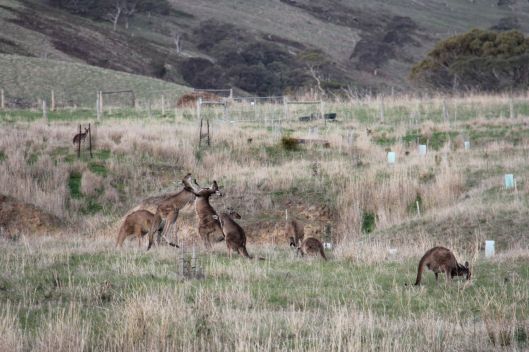
Western Grey Kangaroos fight it out in one of our revegetation habitat zones

One of the most persistent challenges in our work to revegetate areas of the farm has been managing kangaroos. Despite its previous status as woodland, for decades the farm has been an enforced grassland as hay paddock and pasture, the preferred environment of Western Grey Kangaroos. While early accounts of the region describe the southwestern Fleurieu as “kangaroo country”, land clearing, the elimination of predators such as dingoes, reduced hunting pressure, and in our case, the provision of year-round green pick in the form of a nearby irrigated golf course has contributed to a steady increase of kangaroo numbers.

We’ve observed that the kangaroos follow a seasonal rhythm of converging on our property in numbers during the cooler, wetter months, before dispersing into smaller family groups as the weather warms and dries. During this time, they typically move into the neighbouring golf course, and because of the constant availability of fresh feed it is rare to see a female kangaroo without a joey. While most species of kangaroos typically prefer grass, the Western Grey is also noted as a browser of shrubs and seedlings. Continue reading →

New artwork: Fishes of the Fleurieu Coast

30 Saturday Dec 2017

Posted by Joel in art & craft, ecology, exploring

≈ 1 Comment

Tags

art, ecology, etsy, fish, Fleurieu, Fleurieu Coast, illustration, linoprint, ocean, printing, sea, southwestern Fleurieu

IMG_9852

One of the most spectacular elements of the Fleurieu Coast is the proximity of its rolling hills and forested highlands to beaches, reefs and towering rocky cliffs. A few kilometres down the road from Yarnauwi is Second Valley, and beyond that Rapid Bay, both renowned dive locations and in Second Valley’s case, periodically voted as one of the “best beaches” in South Australia and Australia. This new lino print is a tribute to some of the many fish that make their homes among the caves and kelp forests of this region.

Each fish was individually carved and is hand-printed in acid-free, fade-resistant dye ink on Canson cartridge paper. The finished print includes a list of all of the fish depicted hand-written in pencil. The prints are now available online at our Etsy shop.

IMG_9857

Print detail, showing an Old Wife and Southern Sea Garfish.

DSCN0970

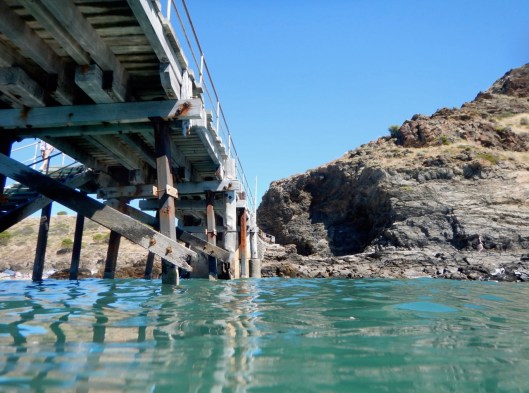
Treading water off the Second Valley Jetty during ‘research’ for this print

← Older posts
Newer posts →

Yarnauwi on Etsy

Enter your email address to follow this blog and receive notifications of new posts by email.

Join 223 other subscribers

What We’re Writing About

alpacas annual report art art and craft bees before and after birds books building cheese climate change craft damara design downloads ecology embroidery erosion etsy events farm fencing fire Fleurieu Fleurieu Coast Fleurieu Peninsula food fungi future hack hiking history illustration insects kangaroos leather leathercraft linoprint livestock logo nursery permaculture photography picnics planning Plastic-free July printing propagation rain recipes recycling regeneration regenerative agriculture reuse revegetation sea seasons seeds shed sheep sheepskins shop soil southwestern Fleurieu summer textiles tour tractor trees ute waste water waterways winter zones

Meta

  • Create account
  • Log in
  • Entries feed
  • Comments feed
  • WordPress.com

Blog at WordPress.com.

  • Subscribe Subscribed
    • Yarnauwi Farm
    • Join 223 other subscribers
    • Already have a WordPress.com account? Log in now.
    • Yarnauwi Farm
    • Subscribe Subscribed
    • Sign up
    • Log in
    • Report this content
    • View site in Reader
    • Manage subscriptions
    • Collapse this bar
 

Loading Comments...