• About
  • Anacotilla: History & Hearsay
  • Junk: A Curated Collection
  • Resources
  • Species List
  • Yarnauwingga and beyond

Yarnauwi Farm

~ Fleurieu Peninsula, South Australia

Yarnauwi Farm

Category Archives: ecology

Yarnauwi Treefest 2019

10 Monday Jun 2019

Posted by Joel in diy, ecology, regeneration, trees, waterways

≈ 8 Comments

Tags

design, ecology, erosion, events, farm, Fleurieu, Fleurieu Coast, nursery, permaculture, propagation, revegetation, seasons, soil, trees, water, waterways, winter

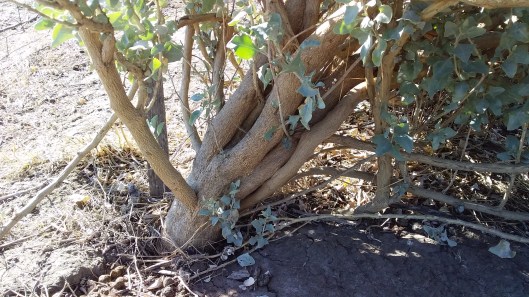
A serial tree-planter manages to synchronise his outfit with the colouring of Eucalyptus occidentalis.

A couple of days before this year’s tree planting, I rang our friend and regular tree-planter Jeremy, and told him that three out of four family members were sick with the flu and we were thinking of cancelling this year’s planting weekend. He didn’t accept that proposal, effectively telling us that tree planting would happen regardless of our involvement, that between his family and another they would take care of catering, rally the volunteers and get the trees in the ground.

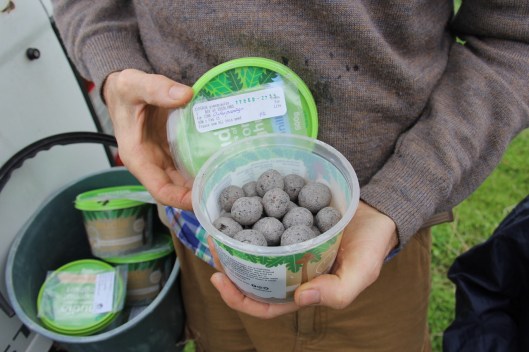
It has always been an aspiration of ours that the farm might offer a place for people to be able to develop connection with the landscape through collaboration on land-based projects – “where people and the landscape can restore each other”. I hope that Jeremy’s response, and the support of our friends and community over the last seven years of tree-planting is an indication of this aspiration in development. In this spirit, this year we were also delighted to host regenerative side projects such as Steven Hoepfner’s seed ball regeneration experiment, and provide a waterway for Sue and David Speck’s sedges, and a forever home for Greg Wood’s trees.

Steven’s seed ball project: local provenance bundles of seed and nutrients distributed across revegetation zones to germinate when the conditions are right.

Continue reading →

Nightlife in the Country

08 Saturday Jun 2019

Posted by Joel in art & craft, ecology, exploring

≈ 4 Comments

Tags

camera, ecology, farm, Fleurieu, Fleurieu Coast, fox, kangaroos, photography, seasons, southwestern Fleurieu, trees, wildlife

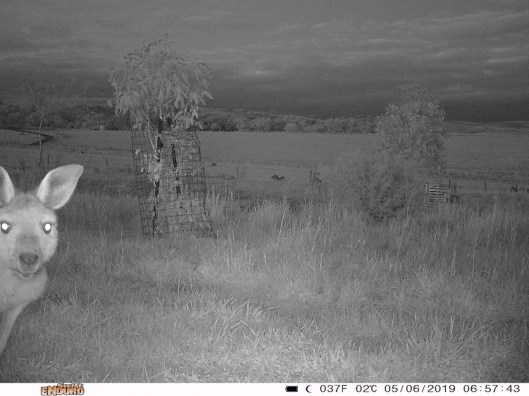
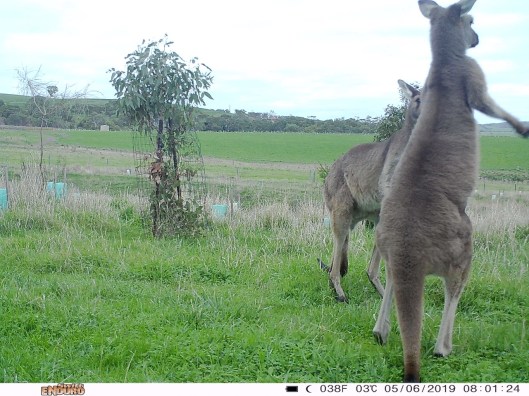
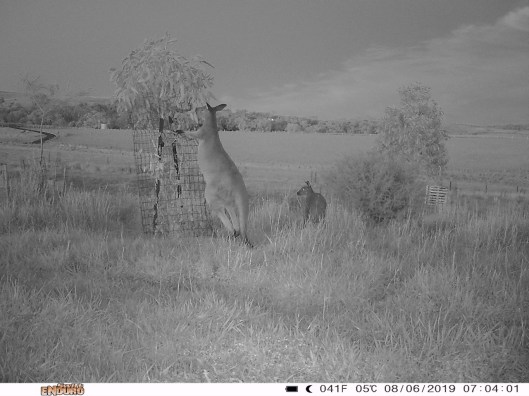
A little while ago I received a motion camera, triggered by movement and able to shoot in complete darkness with an infra-red flash. I mounted it on a fence post, scattered some food scraps in front and left it for a week. Over the week it’s offered us a fascinating window into the life of the farm.

Curious kangaroo

Boxing match

The fight gets out of hand

Persistence is rewarded

Very curious kangaroo.

Unsurprisingly, the hordes of kangaroos feature heavily. They graze through the day and night, occasionally box, and one problem-solver has multiple attempts at reaching  the enticing leaves of a mesh-guarded sapling. Continue reading →

Saltbush city limitless

14 Sunday Apr 2019

Posted by sophie in ecology, livestock, regeneration, trees

≈ 1 Comment

Tags

saltbush

At this time of year when it hasn’t rained properly for about 6 months and even the hardiest of our native trees and shrubs start to wilt, we say thank heavens for saltbush. This family of plants are the Australian climate change gardeners’ morale booster – the hotter and drier it gets the more they seem to leaf out, attract beneficial insects, tower in size over anything else and improve the conditions for other species.

The first species we have had success with, Old Man Saltbush (Atriplex nummularia), grows in inland areas of Australia. Its seeds were traditionally used as a food source for Aboriginal people, and the leaves are also edible and rich in protein, antioxidants, and minerals. It’s commonly used as a livestock grazing plant, which was one of the reasons we planted it, as a high-protein green fodder source at times of the year like this when there is not much else for stock to eat.

20190414_151004

Old Man Saltbush is extremely drought and salt tolerant and apparently lives for more than 100 years! It accumulates salt in its leaves as it extracts water from the soil so can help to reduce salinity. It is very deep rooted and can access moisture and nutrients out of reach of other plants, making those nutrients available to other surface plants via grazing. Its roots travel up to 5m deep and 10m wide to access nutrients and moisture, as well as having surface roots to collect light rain and bind soil. It also sequesters carbon in the soil.

It is fast growing so can provide shelter within a few years to other plants or stock, and works well grown as a hedge/windbreak. I am keen to grow it as a hedge border around a vegetable garden in future as it attracts beneficial insects as well as blocking wind. It seems to grow fine on our heavy clays, though I note it prefers the dryer ridge to the more low lying winter waterlogged areas. And it has such nice grey-blue shimmery leaves! And kangaroos don’t seem to touch it! So much to love. It really is a hero of the plant world.

20190414_151118

Woody trunk after 3 or 4 years growth

Another species we’ve been very grateful to be acquainted with is Creeping Saltbush (Atriplex semibaccata). We planted it on the disturbed slope next to our shed site as a way of stabilising the soil and avoiding erosion and it has thrived. It forms a dense low mat of up to 1.5m diameter, tolerates high levels of salinity and salt-laden winds, tolerates drought, has an edible berry, reduces soil temperature, and provides habitat for beneficial insects. On some of our hottest and driest summer days, it was green and covered in blue copper butterflies!

20190217_114052

Creeping away

And it now seems to be coming up “by itself” (maybe with the help of ants moving fruit around) in a couple of other spots around our shed, not minding growing in gravel at all. This year we are planning to plant it on our gully walls in the hopes of stabilising those slopes, increasing habitat and creating a living mulch around other trees and shrubs.


20190317_123717

Colonising the shed site

Finally, we are always overjoyed to see Ruby Saltbush (Enchylaena tomentosa) popping up by itself in various paddocks around the farm with no help from us (via birds or sheep perhaps). Again the small red fruits are edible, again it is ridiculously hardy tolerating drought, salt, and sand.  Sheep love eating it, but unfortunately they leave nothing behind! And the green leaves are such a sight for sore eyes in this driest time of year.

20190414_093334

We feel we have only just started on our journey experimenting with saltbush, and look forward to encouraging this family of perennial plants to be our allies on the path to increasing productivity and biodiversity.

Treasures from the deep: more curated gully junk

31 Sunday Mar 2019

Posted by Joel in ecology, history, waterways

≈ 4 Comments

Tags

clean up Australia, curated junk, erosion, farm, Fleurieu Coast, photography, Plastic-free July, recycling, regeneration, restoration, reuse, southwestern Fleurieu, textiles, waste

Despite a long silence from us, there’s still lots going on at Yarnauwi, not least our ongoing attempt to clean up historic dumping in our erosion gullies. We feel like we’re closing in on the last 30 metres or so of junk to clear and now we’re so close to finishing it can sometimes be difficult maintaining motivation! While most of the material remaining is steel or demolition rubble, both of which we recycle or repurpose, there are still pockets of wonder in the form of various plastic domestic items. Happily, the plantings established in previously cleared areas are now well-established and working to stablise the exposed gully walls as well as restore them as habitat and an ephemeral waterway. We’ll write with more updates soon, but in the meantime, enjoy these treasures from the deep.

Specimen #51: Plastic clown launcher from a “Dandina Sky Dancer”, released in 1995. This particular clown is from the Italian Masque series of the toy. Intact toys from this series in original packaging are available online for a mere US$75.00. (Thank you to Pascelle for the ID, see comments below)

Specimen #52: Wobbling bear in winter attire.

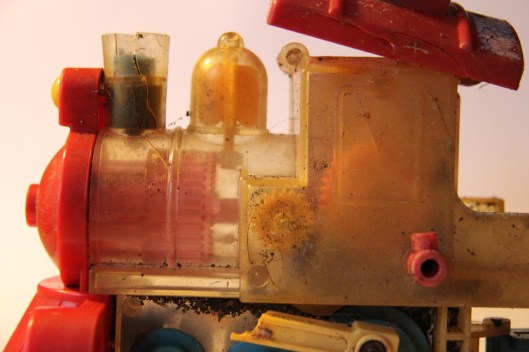
Specimen #53: Battery operated toy train.

Specimen #54: Lightly soiled Boggle Junior console, dating from around 1988. Some cosmetic wear and tear.

Continue reading →

Not ‘if’, but ‘when’: planning for fire

07 Monday Jan 2019

Posted by Joel in ecology, planning, regeneration, trees

≈ 5 Comments

Tags

bushfire, climate change, design, ecology, erosion, farm, fire, Fleurieu, Fleurieu Coast, permaculture, planning, resilience, revegetation, seasons, soil, summer, trees, zones

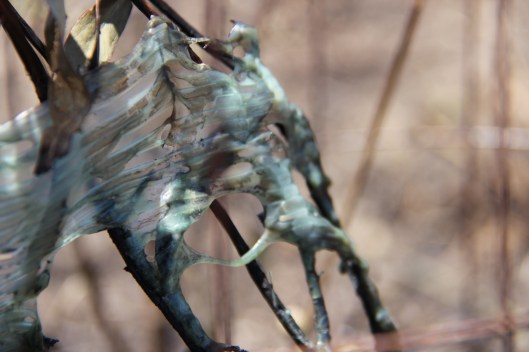
Melted tree guard on a eucalyptus seedling.

A few evenings ago, someone set off fireworks on the road beside our property. Embers from the fireworks landed in the grass on the property boundary and quickly took, spreading through the dry summer grass along the fence and down a drainage line. Thankfully, our neighbours quickly noticed and set to work with their own fire unit while awaiting the arrival of the police and Country Fire Service. The blaze was contained with minimal damage, but it’s stimulated us to revisit our property plans and consider how we’re designing for the inevitability of fire.

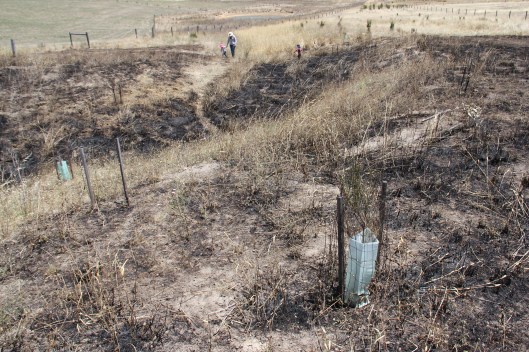
Scorched earth and singed trees.

Continue reading →

A few recent thoughts

23 Sunday Sep 2018

Posted by sophie in books, ecology, planning

≈ 10 Comments

When we “bought” this land, we thought it was a win-win situation. Despite living more than an hour away with a 6 month old baby, we thought that in the best case scenario we could restore the land and develop it into a flourishing farm business and family home. We also thought that if our plans changed in a worst case scenario, just planting some trees and removing the rubbish in the gullies would increase the value of the land and make it a good investment.

What we had not factored in was the power and connection developed through spending time on land and shaping the future of a piece of land. All the working bees with friends and family, pouring sweat and laughter into increasing biodiversity one hole at a time. Observing new birds and insects previously unnoticed. Gazing at the amazing starscape on a still night around the fire. Gradually figuring out the connections between elements of the ecosystems and life cycles of creatures. Getting to know each inch of the place, seeing the changes of the seasons, and from year to year. And it’s exciting how much there is still to learn!

IMG_1294

While there have certainly been times when we have questioned our decisions (particularly when the wind is howling and trees are withering!), I feel that at the moment we are in a place of total contentment, inspiration, and joy at having the privilege to steward this land. The grass is green and some of our worst paddocks are improving in grass diversity and productivity through management decisions. Our trees are growing taller, our shrubs are bushing out, and our sheoak needles are whispering in the wind. Our fig and plum tree are releafing after their winter dormancy. The kangaroo mob has abated, time out working in the sun energises us, and we are witness to processes of water and soil far beyond our control and that hold continuity with the distant past and distant future of this land. This land gives us a healthy sense of perspective at our place in the world, microscopic and very temporary, but able to effect positive change nevertheless.

The recent crop of new books we’ve had in the household have also helped in bringing together some of the disparate observations, ideas and philosophies we’ve had about our work with the land, into some more cohesive strategies for land management.

Unknown-1

“Beyond the War on Invasive Species” by Tao Orion has taught us about the important role that weeds play in moving landscapes through ecological succession. Spraying, tilling, and burning all keep landscapes juvenile when all they want to do is move towards greater levels of complexity. This intersected nicely with an observation by the owner of Deep Creek Organics (which we recently toured) that “all weeds have a role to play”. He pointed to cape weed as an example, and the way it has a deep tap root that can access nutrients further down. We see this too with our weediest cracking clay paddocks, where a profusion of wild turnip in previous years has brought up nutrients, which when slashed, adds organic matter and soil cover and allows other grasses to establish. As a result the paddock is looking much healthier. Rather than feeling frustrated with the profusion of “weeds” where we do not want them, we are trying to see them as agents of change in a landscape and not assuming that is for the worst. They also add diversity to our pasture and offer sheep greater choice and health.
Unknown

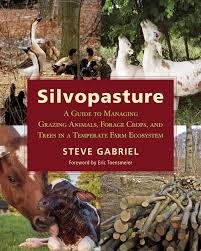
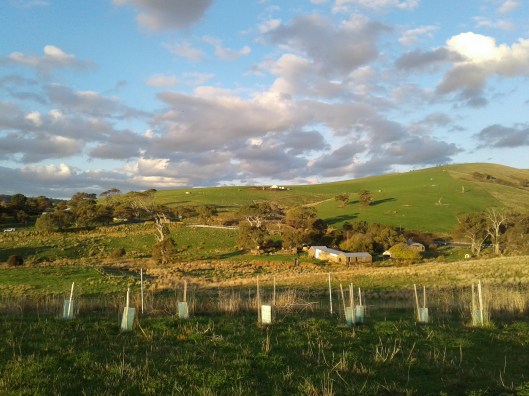
Another great read has been “Silvopasture” by Steve Gabriel, which is a handbook for creating landscapes that marry both grass production for grazing and tree/fodder crops (different to “agroforestry” or “farm forestry” which primarily focuses on tree/timber production), with a focus on sequestering carbon. In fact, silvopasture has been identified by Project Drawdown as one of the most effective agricultural strategies for sequestering carbon. In silvopasture systems, tree and shrub species are carefully managed to maximise both grass production and tree crops, both benefiting the other if done well. While we have experimented with woodlots in a few of our paddocks, we have now planned out our first silvopasture paddock to plant out in 2019, integrating Old Man Saltbush as livestock fodder and nurse plant together with various non-grass-inhibiting species of eucalyptus and sheoak for stock shelter, moisture retention, soil stabilising, and eventually firewood and timber. We are really excited about this new direction for our farm, starting with some of our least productive paddocks that are above eroding gullies which we hope will also slow erosion.

Unknown-3

I have also really enjoyed “Braiding Sweetgrass” by Robin Wall Kimmerer, who is both a biologist and a native American of the Potawotomi nation. She has some incredible insights into plants as teachers, the importance of gratitude, gifts and reciprocity with the non-human-world, and the awe-inspiring traditional relationships of native American communities with other plant and animal species as well as traditional teachings and stories. Such a powerful book, this passage resonated with our work on the land:

“Despair is paralysis. It robs us of agency. It blinds us to our own power and the power of the earth. Environmental despair is a poison every bit as destructive as the methylated mercury in the bottom of Onondaga Lake. But how can we submit to despair while the land is saying “Help”? Restoration is a powerful antidote to despair. Restoration offers concrete means by which humans can once again enter into positive, creative relationship with the more-than-human world, meeting responsibilities that are simultaneously material and spiritual. It’s not enough to grieve. It’s not enough to just stop doing bad things.

We have enjoyed the feast generously laid out for us by Mother Earth, but now the plates are empty and the dining room is a mess. It’s time we started doing the dishes in Mother Earth’s kitchen. Doing dishes has gotten a bad rap, but everyone who migrates to the kitchen after a meal knows that that’s where the laughter happens, the good conversations, the friendships. Doing dishes, like doing restoration, forms relationships.”

Unknown-2

Finally, I have loved “Dawn Again” by Doniga Markegard, a US woman who is a world-renowned wildlife tracker who studied with Jon Young’s Wilderness Awareness School. From tracking she was drawn to permaculture and finally into holistic grazing with an extensive grazing operation in California. The book is her personal journey from childhood to now parenting four children, such an inspirational and affirming read as it also mirrors the evolution of our interests.

I recognise that we have no claims over this land in the way that indigenous peoples do, but I do truly feel that after even a few years of walking and working on this land, we are beginning to have an inkling of what a deep relationship with a landscape can feel like, and a shadow of a sense of how it works. We have entered a bond of reciprocity with the land, and are so grateful for what the land has shared with us.
20180610_164218

Farming fungi

11 Saturday Aug 2018

Posted by Joel in ecology, exploring, regeneration

≈ 3 Comments

Tags

ecology, farm, Fleurieu, Fleurieu Coast, fungi, mycorrhiza, photography, revegetation, seasons, soil, southwestern Fleurieu, trees, winter

Getting excited about fungi on a wet day at Hindmarsh Falls, Fleurieu Peninsula.

In the last year or so we’ve really begun to appreciate the importance of fungi in a living landscape. The fungi (toadstools, mushrooms and so on) we see pop up after rain are the fruiting bodies of sometimes vast underground fungal networks. Some of these fungi form relationships with plant roots that are often mutually beneficial and enhance the plant’s ability to access nutrients and moisture. The Australian National Botanic Gardens suggest that some 80-90% of Australian plants form or benefit from mycorrhizal networks (fungal associations), and may derive up to 30% of their food through this symbiotic relationship. Continue reading →

Making a floating habitat island

12 Thursday Jul 2018

Posted by Joel in ecology, propagation, regeneration, waterways

≈ 2 Comments

Tags

birds, dam, design, ecology, habitat, how to, island, making, revegetation, water, waterways

DCIM100GOPRO

The planted habitat island, ready to launch

Regular readers and supporters of our farm will be familiar with the challenges we’ve faced trying to re-establish native vegetation in the face of large populations of rampaging herbivores. Inspired by an idea from @nature_at_work_ (check them out on Instagram) and folks around the world working to increase urban and rural habitat, we thought we’d construct a floating habitat island.

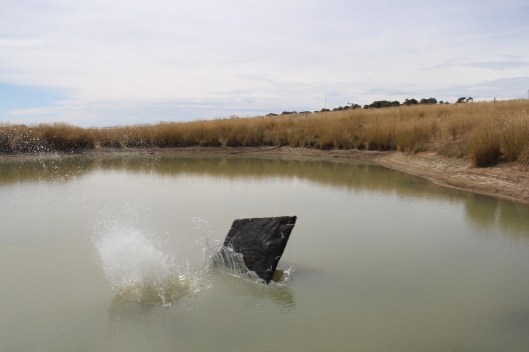
Once installed in the dam, we hoped the island would function as a seed bank for aquatic plants, a fox-proof roost for waterbirds, and offer filtration through the plant roots as well as aquatic shelter and habitat.

During the summer, our friend Shani, assisted by a team of kids, got to work assembling a frame from some leftover PVC stormwater pipe to act as the float, with a length of shade cloth salvaged from our gully junk to act as a base onto which we could later plant local aquatic plants. The frame was tied to a rock anchor and then launched with great ceremony.

IMG_9909

The official launch of the habitat island (and anchor)

IMG_9910

Installation requires a great deal of precision and technical know-how.

In the following months, the island became popular with waterbirds of all types, with ducks often spotted perched on the floating edge, grebes diving underneath and the enclosed centre of the island becoming coated with feathers and bird manure. Continue reading →

The Occasional Farmers’ Book club: Discovering Aldo Leopold

01 Sunday Jul 2018

Posted by Joel in books, ecology, history

≈ Leave a comment

Tags

Aldo Leopold, books, ecology, history

51UByRehjhL._SX302_BO1,204,203,200_

I’d never read the work of Aldo Leopold, but always had a vibe that philosophically we might have something in common. He’s one of the most prominent voices from the early North American conservation movement and I’d read of him regularly and particularly of the “Land Ethic” he articulated. I finally tracked down a copy of one of his influential works A Sand County Almanac, bundled with some essays from Round River, and published posthumously in 1949. I have a friend who once became enraged by how Thoreau’s work seemed to primarily be read in pull-quote form on social media or on email footers, and Leopold too is eminently quotable. In that spirit, this article will really be a collection of salient quotes tenuously connected with our own experience.

Country
About three fifths of my volume of A Sand County Almanac is dedicated to Leopold’s observations of his Wisconsin home, together with sections reflecting on other landscapes of North America. While his meditations on geese landing on ponds and the accumulated wisdom of pine trees are a beautiful thing, I admit I skipped over some of this section to get to his more directly philosophical work. One of his central arguments is about the need to separate economic perceptions of value from our appreciation of the landscape, with a particular focus on acknowledging the social and cultural importance of a landscape and the intrinsic worth of ecological diversity and resilience. From his essay Country,

There is much confusion between land and country. Land is the place where corn, gullies and mortgages grow. Country is the personality of land, the collective harmony of its soil, life, and weather. … Poor land may be rich country, and vice versa. Only economists mistake physical opulence for riches. Country may be rich despite a conspicuous poverty of physical endowment, and its quality may not be apparent at first glance, nor at all times. … In country, as in people, a plain exterior often conceals hidden riches, to perceive which requires much living in and with.

For me this echoes the tension we’re trying to navigate with Yarnauwi, to transition the landscape away from one that has grown gullies and mortgages for generations to one that again supports a diversity and complexity of lives, and that acknowledges and inhabits the many cultural stories that have shaped it. If we think about the permaculture principle of “obtaining a yield”, Leopold suggests that the yield may not be economic or even tangible, but can still be something of value. Continue reading →

Tree-fest 2018: Six years and growing

11 Monday Jun 2018

Posted by Joel in ecology, propagation, regeneration, trees, waterways

≈ 2 Comments

Tags

community, Fleurieu, Fleurieu Coast, revegetation, tree planting, trees, winter

Volunteers planting at the very first Yarnauwi tree planting extravaganza, 2013

The work continues in 2018 with new plantings amid established trees.

Six years ago we first invited friends and family to come and plant trees at Yarnauwi. They came, dug holes in a windswept paddock, hunched their shoulders against the cold and ate lunch beneath one of the property’s two big old red gums. That first year most of the plants were devoured by kangaroos and deer. Amazingly, our friends and family came back the following year and every year since, with the tree-planting weekend growing into an annual celebration of moist ground and hope for the future.

Loyal volunteers work on a windbreak

Continue reading →

← Older posts
Newer posts →

Yarnauwi on Etsy

Enter your email address to follow this blog and receive notifications of new posts by email.

Join 223 other subscribers

What We’re Writing About

alpacas annual report art art and craft bees before and after birds books building cheese climate change craft damara design downloads ecology embroidery erosion etsy events farm fencing fire Fleurieu Fleurieu Coast Fleurieu Peninsula food fungi future hack hiking history illustration insects kangaroos leather leathercraft linoprint livestock logo nursery permaculture photography picnics planning plants Plastic-free July printing propagation rain recycling regeneration regenerative agriculture reuse revegetation sea seasons seeds shed sheep sheepskins shop soil southwestern Fleurieu stiles summer textiles tractor trees ute waste water waterways winter zones

Meta

  • Create account
  • Log in
  • Entries feed
  • Comments feed
  • WordPress.com

Blog at WordPress.com.

  • Subscribe Subscribed
    • Yarnauwi Farm
    • Join 223 other subscribers
    • Already have a WordPress.com account? Log in now.
    • Yarnauwi Farm
    • Subscribe Subscribed
    • Sign up
    • Log in
    • Report this content
    • View site in Reader
    • Manage subscriptions
    • Collapse this bar
 

Loading Comments...