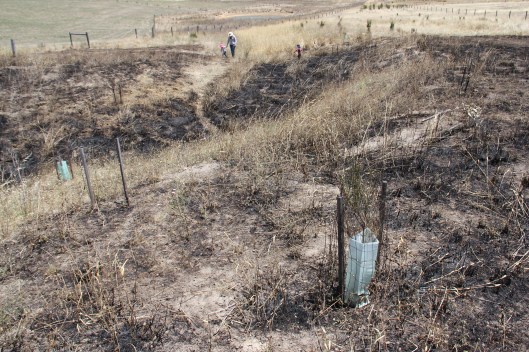
A few evenings ago, someone set off fireworks on the road beside our property. Embers from the fireworks landed in the grass on the property boundary and quickly took, spreading through the dry summer grass along the fence and down a drainage line. Thankfully, our neighbours quickly noticed and set to work with their own fire unit while awaiting the arrival of the police and Country Fire Service. The blaze was contained with minimal damage, but it’s stimulated us to revisit our property plans and consider how we’re designing for the inevitability of fire.
Getting excited about fungi on a wet day at Hindmarsh Falls, Fleurieu Peninsula.
In the last year or so we’ve really begun to appreciate the importance of fungi in a living landscape. The fungi (toadstools, mushrooms and so on) we see pop up after rain are the fruiting bodies of sometimes vast underground fungal networks. Some of these fungi form relationships with plant roots that are often mutually beneficial and enhance the plant’s ability to access nutrients and moisture. The Australian National Botanic Gardens suggest that some 80-90% of Australian plants form or benefit from mycorrhizal networks (fungal associations), and may derive up to 30% of their food through this symbiotic relationship. Continue reading →
Regular readers and supporters of our farm will be familiar with the challenges we’ve faced trying to re-establish native vegetation in the face of large populations of rampaging herbivores. Inspired by an idea from @nature_at_work_ (check them out on Instagram) and folks around the world working to increase urban and rural habitat, we thought we’d construct a floating habitat island.
Once installed in the dam, we hoped the island would function as a seed bank for aquatic plants, a fox-proof roost for waterbirds, and offer filtration through the plant roots as well as aquatic shelter and habitat.
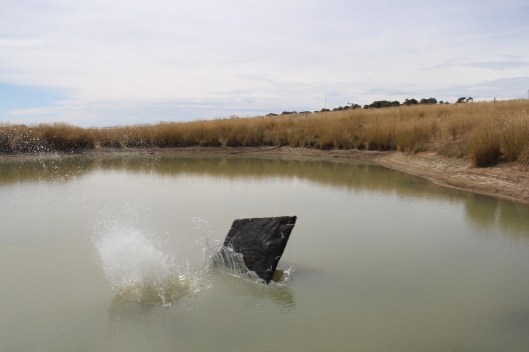
During the summer, our friend Shani, assisted by a team of kids, got to work assembling a frame from some leftover PVC stormwater pipe to act as the float, with a length of shade cloth salvaged from our gully junk to act as a base onto which we could later plant local aquatic plants. The frame was tied to a rock anchor and then launched with great ceremony.
The official launch of the habitat island (and anchor)
Installation requires a great deal of precision and technical know-how.
In the following months, the island became popular with waterbirds of all types, with ducks often spotted perched on the floating edge, grebes diving underneath and the enclosed centre of the island becoming coated with feathers and bird manure. Continue reading →
Volunteers planting at the very first Yarnauwi tree planting extravaganza, 2013
The work continues in 2018 with new plantings amid established trees.
Six years ago we first invited friends and family to come and plant trees at Yarnauwi. They came, dug holes in a windswept paddock, hunched their shoulders against the cold and ate lunch beneath one of the property’s two big old red gums. That first year most of the plants were devoured by kangaroos and deer. Amazingly, our friends and family came back the following year and every year since, with the tree-planting weekend growing into an annual celebration of moist ground and hope for the future.
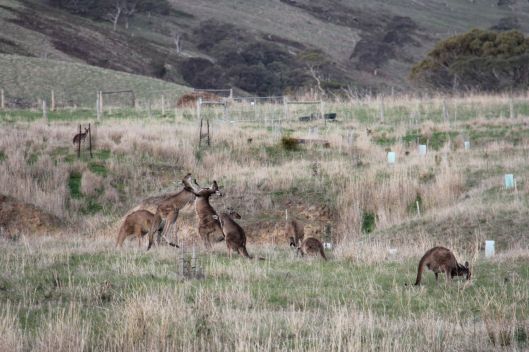
Western Grey Kangaroos fight it out in one of our revegetation habitat zones
One of the most persistent challenges in our work to revegetate areas of the farm has been managing kangaroos. Despite its previous status as woodland, for decades the farm has been an enforced grassland as hay paddock and pasture, the preferred environment of Western Grey Kangaroos. While early accounts of the region describe the southwestern Fleurieu as “kangaroo country”, land clearing, the elimination of predators such as dingoes, reduced hunting pressure, and in our case, the provision of year-round green pick in the form of a nearby irrigated golf course has contributed to a steady increase of kangaroo numbers.
We’ve observed that the kangaroos follow a seasonal rhythm of converging on our property in numbers during the cooler, wetter months, before dispersing into smaller family groups as the weather warms and dries. During this time, they typically move into the neighbouring golf course, and because of the constant availability of fresh feed it is rare to see a female kangaroo without a joey. While most species of kangaroos typically prefer grass, the Western Grey is also noted as a browser of shrubs and seedlings. Continue reading →
Impatient as we are, we’ve become slightly obsessive about “before-and-after” photos in an effort to stay inspired about the possibilities for landscape transformation. About 15 minutes down the road from Yarnauwi, our friends David and Gillian have been gradually revegetating a former grazing property in the hills above Cape Jervis. Perhaps because of its steepness, the property has retained a good number of big old pink gums, together with the occasional ancient sheoak, offering the beginnings of a canopy for regeneration. Seven years ago we helped out with one of their first planting weekends, and I recently unearthed some photos taken at that time. With David, we recently walked around the property to admire the last seven years of growth.
View 1: 2010
View 1: 2017
David and Gillian have been philosophical about kangaroo grazing, with plants getting no more protection than korflute guards. Some plants have been repeatedly mowed down, reaching no higher than the tree guard after seven years, while others have finally stretched above mouth height and are now heading skywards. David notes that no plants were about adult should height for the first five years – something we can relate to at Yarnauwi. Continue reading →
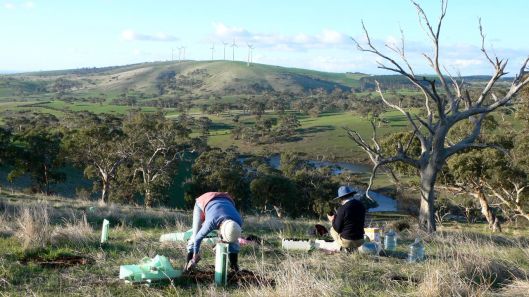
“Trees are the poems the earth writes upon the sky” said Kahlil Gibran. Pete, Shani and Sophie prepare to plant.
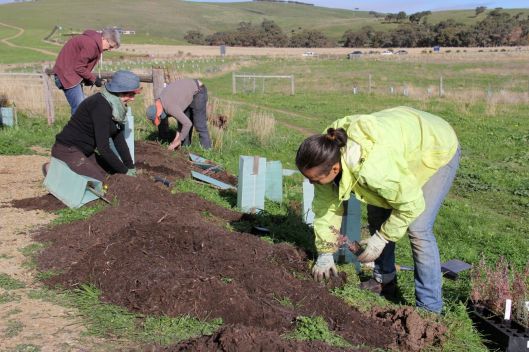
This year is our fifth on Yarnauwi, and this June saw our fifth annual tree-planting extravaganza. Over the last five years, our amazing community of tree planters and supporters have planted 5000 trees and other plants on Yarnauwi as we work to restore woodland, stabilise and repair erosion and plant trees for future timber, forage and food. Following the last four years of observation and experimentation, in 2017 our main focus was planting carefully selected species into some of the more challenging areas of the property. Each year we’ve propagated and planted trees sourced from both Trees for Life and our own seed collection. In addition to their generous labour and time, we’re honoured that Yarnauwi regulars Richard and Marg have now immortalised the annual tree-planting tradition in a musical saga, published below and sung to the tune of Loudon Wainwright’s The Swimming Song. The lyricists also pre-emptively apologise for any character assassination contained within.
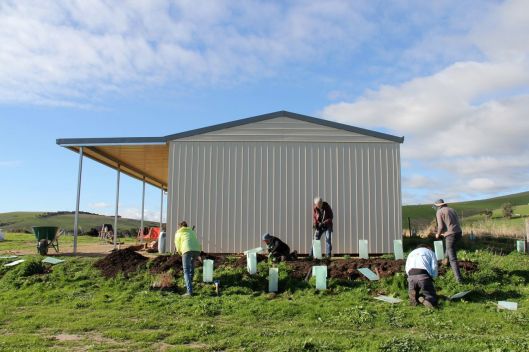
Putting in soil-stabilising groundcovers around the shed.
A week or two following the tree-planting extravaganza, we were delighted to host the Permaculture Association of South Australia for a walking tour and lunch, sharing our property planning process and how we’ve approached the landscape restoration through a permaculture lens – of which these plantings are a central element. Thank you to Tree Team 2017: Anthony, Pete, Shani, Arlo, Freya, Jeremy, Claire, Innis, Sal, Mary, Branny, Richard, Marg, Nat, Jess, Oliver, Gillian, David, Geoff and Andrew.
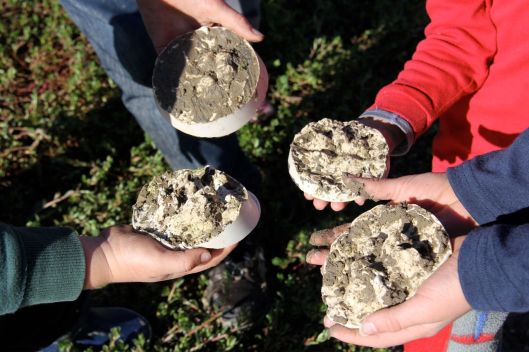
One of the electives at this year’s tree-planting fiesta was making plaster casts of animal tracks. Here we have a collection of fox tracks from the dam’s edge.
Guests take a tour of one of the revegetation areas, inspecting the growth of four years of planting. Photo by Jeff Catchlove.
On a balmy autumn afternoon, we celebrated the new shed with sixty of Yarnauwi Farm’s friends and supporters. Following a tour of the farm, we settled into a shared dinner and drinks by the campfire.
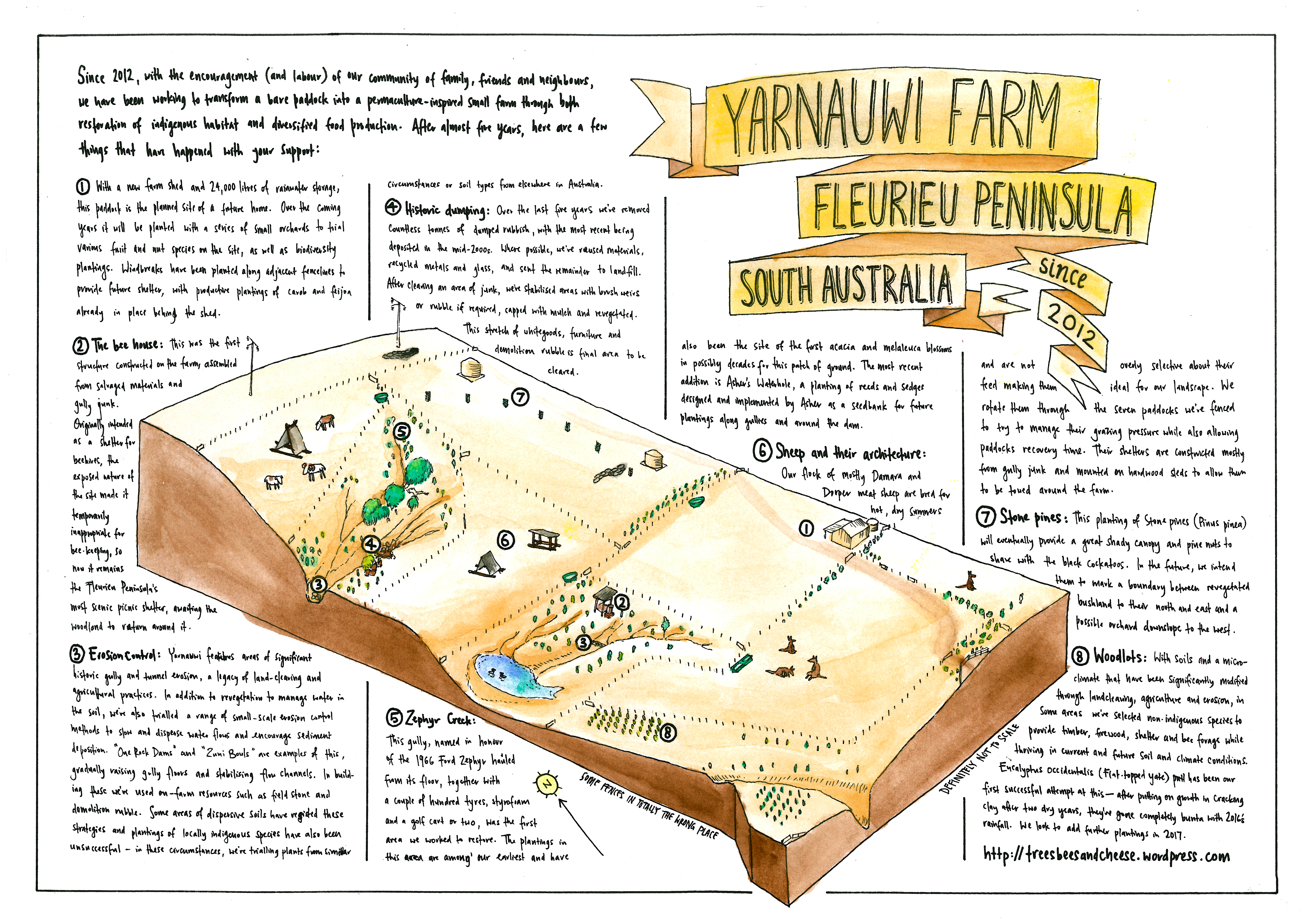
To mark the occasion we also produced a self-guided tour map of important developments and points of interest on the property, hard copies of which were gifted to our guests to be stuck on fridges and toilet doors.
Yarnauwi Farm Self-Guided Map. (Click for a printable A3 version).
The changes that have occurred at Yarnauwi over the last four-and-a-half-years have only been possible through the encouragement, support and labour of our community of friends, neighbours and family. We hope that this celebration went some way towards expressing how grateful we are.
In birthday cards I often wish the recipient a coming year of “the right kind of challenge”, optimistically suggesting it will herald positive growth and empowerment through problem-solving and negotiation. This year, I got a taste of my own medicine, with a winter of biblical proportions just the beginning of the challenges.
November marks four years since we began the Yarnauwi project. Four years of attempting to regenerate the property to our optimistic standards on the weekends, of packing and unpacking the car, of ferrying and entertaining one, then two, small children, of revegetating, managing erosion, managing pasture, managing water, managing livestock, managing weeds and managing the legacy of past land managers. These are all admirable, ambitious intentions, and what we’ve achieved has only been possible through the support and enthusiasm of our community of neighbours, friends and family. Continue reading →
The first big storm saw the dam fill and rivers broaden to ten times their normal size for an afternoon. A neighbour’s creek crossing dissolved in the flow, the rock and rubble broadcast along the river bottom. The second big storm saw our rainwater tank, still awaiting a shed to fill it, lifted vertically from its nest of stardroppers, vaulting a tractor and four or five fences before being swept off in the swollen waters of the Anacotilla River, carried across two properties and wedged under a red gum. The third storm came with days of warnings, threats of winds over 120km/h and rainfall to rival all of the previous deluges. It left all of South Australia without electricity, the farm a sucking, gurgling swamp, and me walking home through a darkened, scrambling city.
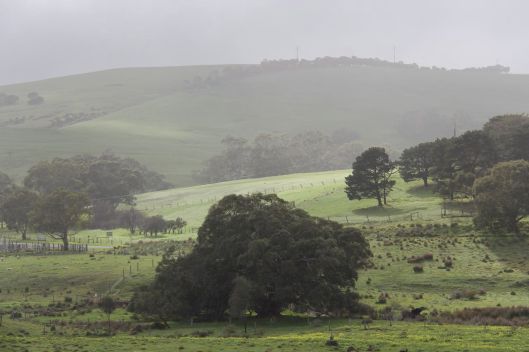
Mist in the valleys
It’s been a demanding few months on the farm. The persistent moisture has made the ground unworkable, most of the farm inaccessible except on foot and the weather generally hostile to both our motivation and ability to do anything useful. The vast quantities of rain we’ve received however, have meant that moisture has permeated deep into the subsoil, so we console ourselves with the hope that as the weather warms, our tree plantings (including those from earlier this winter) will rocket skywards. Continue reading →









 Yarnauwi Farm