A little while ago I received a motion camera, triggered by movement and able to shoot in complete darkness with an infra-red flash. I mounted it on a fence post, scattered some food scraps in front and left it for a week. Over the week it’s offered us a fascinating window into the life of the farm.
Curious kangaroo
Boxing match
The fight gets out of hand
Persistence is rewarded
Very curious kangaroo.
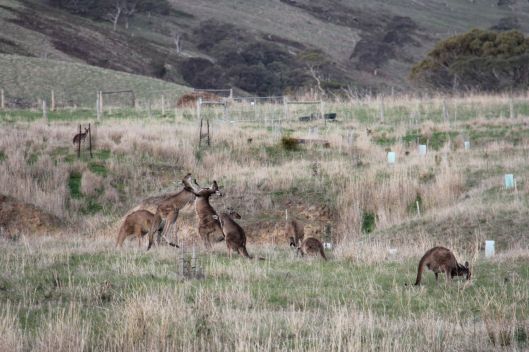
Unsurprisingly, the hordes of kangaroos feature heavily. They graze through the day and night, occasionally box, and one problem-solver has multiple attempts at reaching the enticing leaves of a mesh-guarded sapling. Continue reading →
Despite a long silence from us, there’s still lots going on at Yarnauwi, not least our ongoing attempt to clean up historic dumping in our erosion gullies. We feel like we’re closing in on the last 30 metres or so of junk to clear and now we’re so close to finishing it can sometimes be difficult maintaining motivation! While most of the material remaining is steel or demolition rubble, both of which we recycle or repurpose, there are still pockets of wonder in the form of various plastic domestic items. Happily, the plantings established in previously cleared areas are now well-established and working to stablise the exposed gully walls as well as restore them as habitat and an ephemeral waterway. We’ll write with more updates soon, but in the meantime, enjoy these treasures from the deep.
Specimen #51: Plastic clown launcher from a “Dandina Sky Dancer”, released in 1995. This particular clown is from the Italian Masque series of the toy. Intact toys from this series in original packaging are available online for a mere US$75.00. (Thank you to Pascelle for the ID, see comments below)
Specimen #52: Wobbling bear in winter attire.
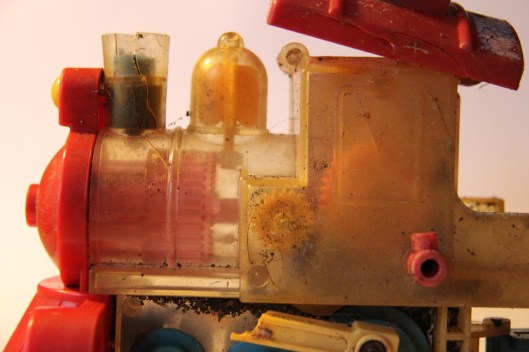
Specimen #53: Battery operated toy train.
Specimen #54: Lightly soiled Boggle Junior console, dating from around 1988. Some cosmetic wear and tear.
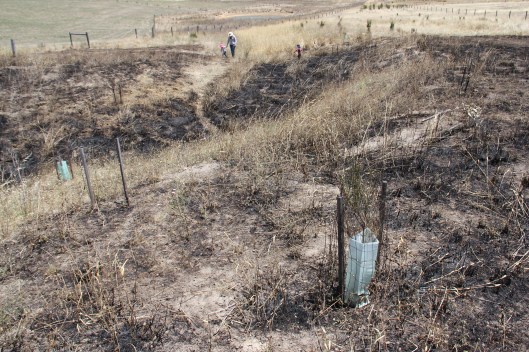
A few evenings ago, someone set off fireworks on the road beside our property. Embers from the fireworks landed in the grass on the property boundary and quickly took, spreading through the dry summer grass along the fence and down a drainage line. Thankfully, our neighbours quickly noticed and set to work with their own fire unit while awaiting the arrival of the police and Country Fire Service. The blaze was contained with minimal damage, but it’s stimulated us to revisit our property plans and consider how we’re designing for the inevitability of fire.
Getting excited about fungi on a wet day at Hindmarsh Falls, Fleurieu Peninsula.
In the last year or so we’ve really begun to appreciate the importance of fungi in a living landscape. The fungi (toadstools, mushrooms and so on) we see pop up after rain are the fruiting bodies of sometimes vast underground fungal networks. Some of these fungi form relationships with plant roots that are often mutually beneficial and enhance the plant’s ability to access nutrients and moisture. The Australian National Botanic Gardens suggest that some 80-90% of Australian plants form or benefit from mycorrhizal networks (fungal associations), and may derive up to 30% of their food through this symbiotic relationship. Continue reading →
Western Grey Kangaroos fight it out in one of our revegetation habitat zones
One of the most persistent challenges in our work to revegetate areas of the farm has been managing kangaroos. Despite its previous status as woodland, for decades the farm has been an enforced grassland as hay paddock and pasture, the preferred environment of Western Grey Kangaroos. While early accounts of the region describe the southwestern Fleurieu as “kangaroo country”, land clearing, the elimination of predators such as dingoes, reduced hunting pressure, and in our case, the provision of year-round green pick in the form of a nearby irrigated golf course has contributed to a steady increase of kangaroo numbers.
We’ve observed that the kangaroos follow a seasonal rhythm of converging on our property in numbers during the cooler, wetter months, before dispersing into smaller family groups as the weather warms and dries. During this time, they typically move into the neighbouring golf course, and because of the constant availability of fresh feed it is rare to see a female kangaroo without a joey. While most species of kangaroos typically prefer grass, the Western Grey is also noted as a browser of shrubs and seedlings. Continue reading →
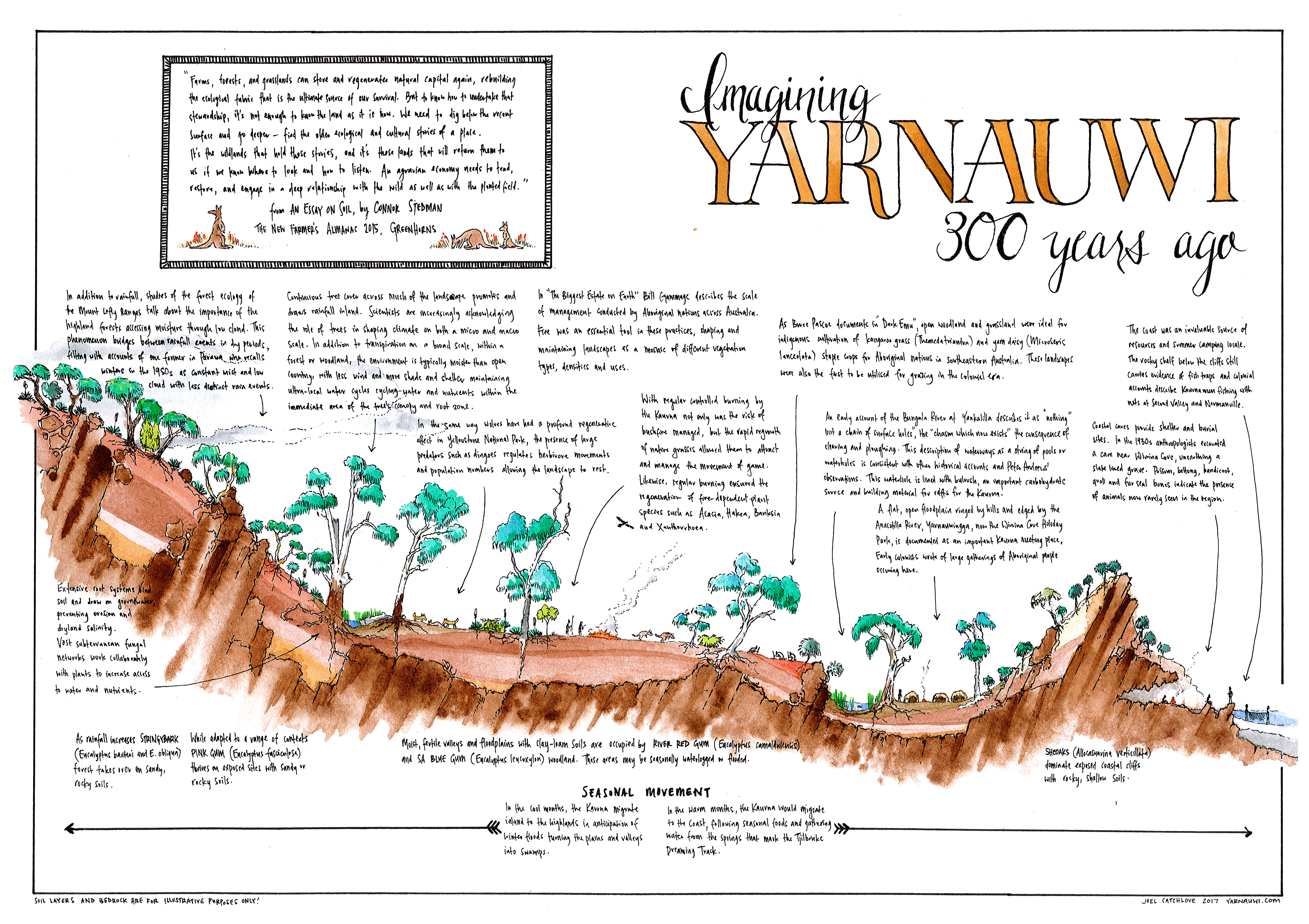
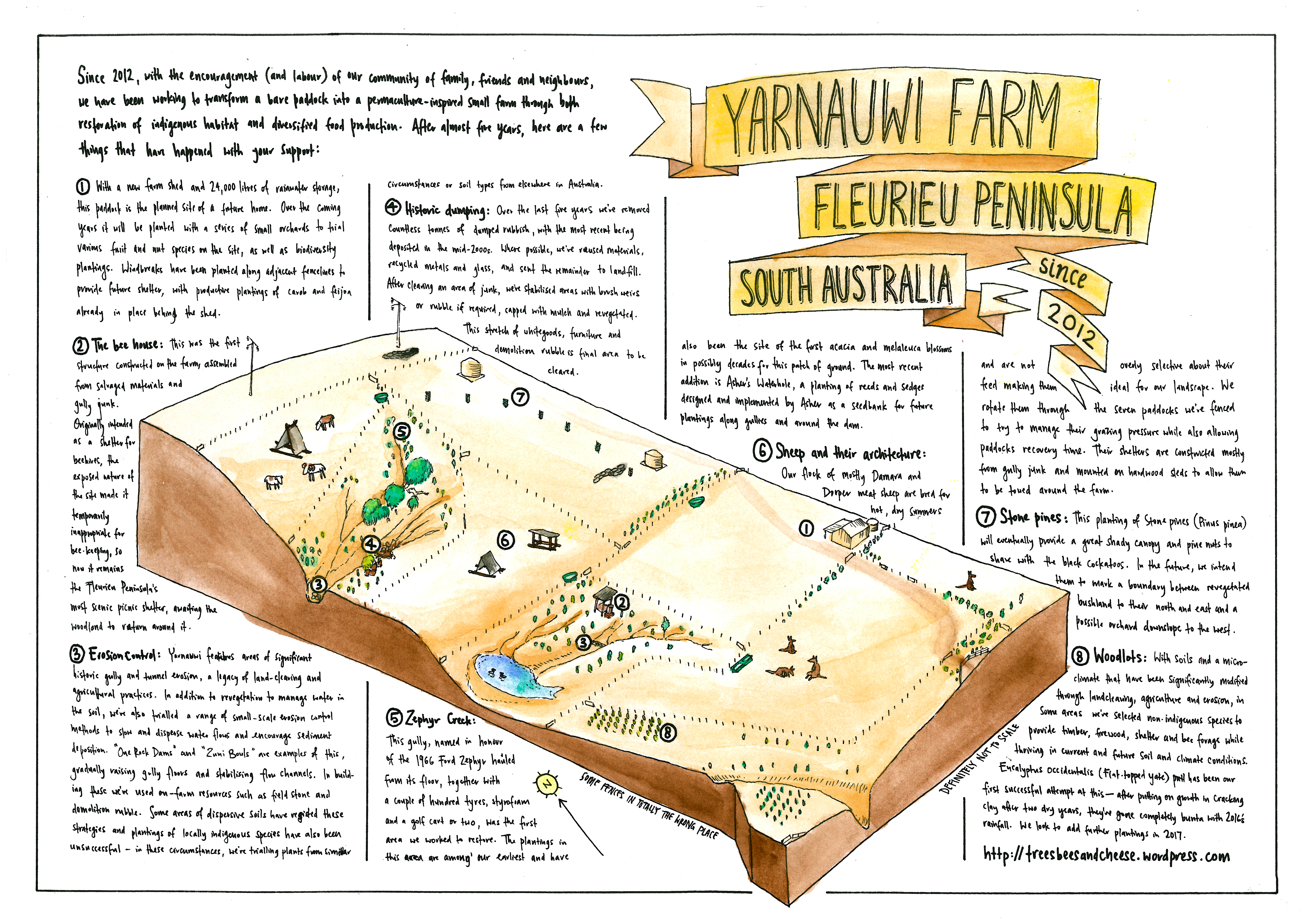
Click to view a printable, A3 version of the poster.
Over the last few years, we’ve spent a great deal of time learning about the landscape of Yarnauwi, and the broader southwestern Fleurieu Peninsula. This has been essential for us in helping us to understand how the landscape works, and therefore how we can best work to ensure its health and function. We’re inspired by a statement from the 2015 Greenhorns New Farmer’s Almanac, where Connor Stedman writes, “Farms, forests, and grasslands can store and regenerate natural capital again, rebuilding the ecological fabric that is the ultimate source of our prosperity and survival. But to know how to undertake that stewardship, it’s not enough to know the land as it is now. We need to dig below the recent surface and go deeper – find the older ecological and cultural stories of a place. It’s the wildlands that hold these stories, and it’s these lands that will return them to us if we know where to look and how to listen. An agrarian economy needs to tend, restore and engage in a deep relationship with the wild as well as the planted field.”
In this spirit, in this poster we’ve tried to imagine and illustrate the landscape of Yarnauwi and the surrounding area as it may’ve appeared before colonisation. It summarises our reading and research, as well as our experiences exploring more intact local landscapes. It’s a work of imagination, it’s definitely not to scale, but we hope it helps communicate some of the complexity of a functioning landscape and the interactions of the Kaurna in maintaining its function and ecological health over millennia. Then, as now, the southwestern Fleurieu was a cultural landscape, maintained through intentional management practices. This poster is also an effort to acknowledge our own place in the long history of this landscape. Continue reading →
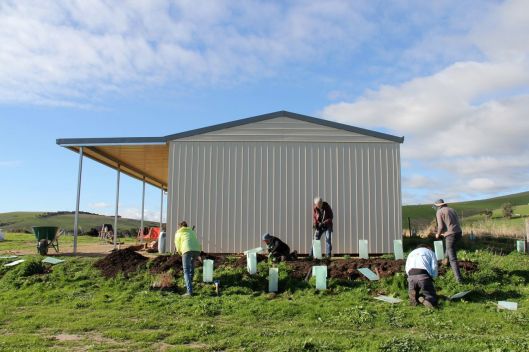
“Trees are the poems the earth writes upon the sky” said Kahlil Gibran. Pete, Shani and Sophie prepare to plant.
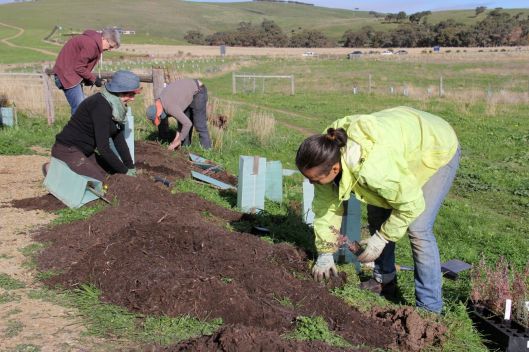
This year is our fifth on Yarnauwi, and this June saw our fifth annual tree-planting extravaganza. Over the last five years, our amazing community of tree planters and supporters have planted 5000 trees and other plants on Yarnauwi as we work to restore woodland, stabilise and repair erosion and plant trees for future timber, forage and food. Following the last four years of observation and experimentation, in 2017 our main focus was planting carefully selected species into some of the more challenging areas of the property. Each year we’ve propagated and planted trees sourced from both Trees for Life and our own seed collection. In addition to their generous labour and time, we’re honoured that Yarnauwi regulars Richard and Marg have now immortalised the annual tree-planting tradition in a musical saga, published below and sung to the tune of Loudon Wainwright’s The Swimming Song. The lyricists also pre-emptively apologise for any character assassination contained within.
Putting in soil-stabilising groundcovers around the shed.
A week or two following the tree-planting extravaganza, we were delighted to host the Permaculture Association of South Australia for a walking tour and lunch, sharing our property planning process and how we’ve approached the landscape restoration through a permaculture lens – of which these plantings are a central element. Thank you to Tree Team 2017: Anthony, Pete, Shani, Arlo, Freya, Jeremy, Claire, Innis, Sal, Mary, Branny, Richard, Marg, Nat, Jess, Oliver, Gillian, David, Geoff and Andrew.
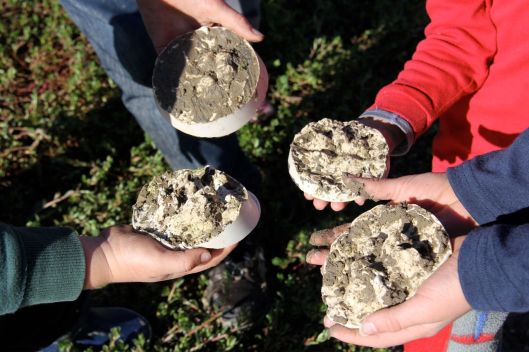
One of the electives at this year’s tree-planting fiesta was making plaster casts of animal tracks. Here we have a collection of fox tracks from the dam’s edge.
Guests take a tour of one of the revegetation areas, inspecting the growth of four years of planting. Photo by Jeff Catchlove.
On a balmy autumn afternoon, we celebrated the new shed with sixty of Yarnauwi Farm’s friends and supporters. Following a tour of the farm, we settled into a shared dinner and drinks by the campfire.
To mark the occasion we also produced a self-guided tour map of important developments and points of interest on the property, hard copies of which were gifted to our guests to be stuck on fridges and toilet doors.
Yarnauwi Farm Self-Guided Map. (Click for a printable A3 version).
The changes that have occurred at Yarnauwi over the last four-and-a-half-years have only been possible through the encouragement, support and labour of our community of friends, neighbours and family. We hope that this celebration went some way towards expressing how grateful we are.
We’ve always been excited about fruit and nut trees. However, with our erosive, heavy clay soils we felt that the standard method of deep ripping for orchard preparation seemed inappropriate for our circumstances. Instead, with some research, we thought we’d experiment with a mounded method, building soil up on contour to catch rainwater while improving soil structure from the top down.
Wrestling the rotary hoe for the first till of the soil.
We began with constructing a shortlist of common species that are likely to be successful in our climate and soil type. Our intention is to construct a series of small-scale, experimental plantings around the farm before scaling up the most successful species and soil preparation methods. Continue reading →
The Yarnauwi skyline is changing: some is grown, some is constructed.
A ‘Grand Design’ it isn’t, but the Yarnauwi farm shed has seen enough delays to make even Kevin McCloud blush. After 14 months, our simple 4-bay equipment shed is finally done. Ordered in January 2016, with the shed company suggesting an initial completion date of June 2016, this modest structure was beset with delays ranging in scale from an apocalyptic winter through to urban tradies that couldn’t quite stomach the prospect of venturing beyond suburbia.