There’s something different about you…

Tags

, , , , , ,

IMG_3630River red gums (Eucalyptus camaldulensis) are notorious limb droppers. With the recent blistering temperatures (Adelaide’s been experiencing been experiencing strings of days above 40 degrees Celcius, and the normally milder Southern Fleurieu has had days in the early 40s) and a burst of gale-force winds, one of our two remnant red gums has lived up to its notoriety. Continue reading

Ross Reborn: Fixing the Tractor

Tags

, ,

IMG_3617A little while ago, some very generous friends offered us an old tractor that wasn’t suitable for their needs. We took delivery of the 1960s McCormick International Harvester A414 a few months ago, and while it mostly seemed to work, shortly after arriving some hydraulic lines blew-out, leaving the tractor unmovable. We contacted a couple of local mechanics to come out and have a look, generally receiving a response along the lines of “Fix it yourself.” While I’m not sure about how that works for them as a business model, it’s definitely in the spirit of the tractor, designed to be maintained, fixed and customised indefinitely with the assistance of a manual and some creativity.

IMG_3591After several weekends of tinkering, evenings of poring over manuals and the occasional visit to auto-parts shops, the mighty A414 roared into life. It handles like an ocean liner, sounds like a freight train and gets from 0-10km/h in a time comparable to the entire Jurassic Era, but boy, that slasher sliced through the dry grass of next winter’s reveg plantings like only spinning steel can. Continue reading

Clearing the Junk (aka. Ute-based Art)

Tags

, , , , , , ,

IMG_3569_2

“Tangents in the landscape” (detail), 2014, mixed media installation, fencing wire, ratchet straps and Holden Rodeo ute

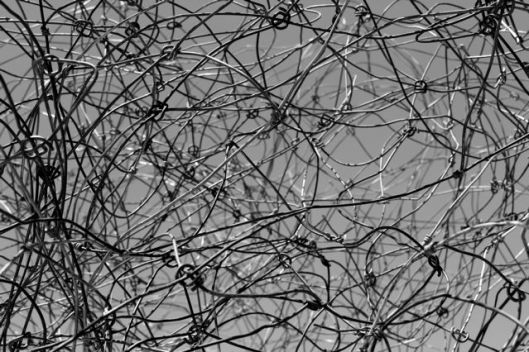
A day spent hauling junk out of gullies can put you in a philosophical mood. When we first purchased this property, we were drawn to the erosion gullies filled with generations of farm rubbish with a kind-of masochistic fascination. After a year of hauling, stacking and shunting loads to the dump or recycling depot, today we loaded up our ute with the final bundles of unruly and ancient fencing wire.

IMG_3413

Bye-bye horror horse!

The most recent round of dump trips has also been momentous in that it finally marks the banishment of a terrifying, rusted and threadbare rocking horse from the property. The horror horse, wedged between rusted 44-gallon drums stuffed with irrigation pipe and topped with a decaying mattress, formed one in a series of mobile art installations mounted on the back of the ute, displayed for a brief, one-time-only journey between our block and the Yankalilla dump. A number of more conceptual, minimalist pieces followed shortly after, composed of snarls of fencing wire of assorted vintage. Continue reading

Been & Gone: The Hive Takes Flight

Tags

, , , ,

A couple of weeks ago, we checked the hive and all seemed well. We found the queen, the bees were busy and on opening the hive there was the seductive scent of honey. The colony had spent weeks drawing out the honeycomb on the hive frames, and seemed to be just beginning to lay a good pattern of brood (young).

IMG_3250

Spot the queen

There were a few ants that seemed to be making a nuisance of themselves. The bees would try to expel them from the hive, while the ants would cling on to their legs and wings pulling them off-balance. After a little research, we thought we’d apply cinnamon, a widely recommended treatment for ant problems. The bees were irritated by it, and the ants unmoved. Next, we constructed a hive stand with the intention of putting the legs in tins of oil as a physical barrier for the ants, but unfortunately for us, it was too late. Continue reading

Cheese Notes: Mozzarella-making

Tags

, ,

You may be wondering where the cheese part comes in to Trees, Bees and Cheese. One of our plans is to eventually run dairy sheep and have a small-scale artisanal cheese business, to complement the other income streams on a diverse farm. But in the meantime, we are busy honing and expanding our cheese-making skills.

IMG_2494

Our first camembert, ready to eat.

After learning how to make haloumi, ricotta, and goat curd from Lulu of Culinary Art Productions, and teaching ourselves a modern camembert from Cheeselinks‘ book Home Cheesemaking, the next cheesemaking frontier has been good old child-friendly mozzarella. Continue reading

The First Phase of Fencing: Marking Zone 5

Tags

, , , , , , , , , , ,

IMG_3241

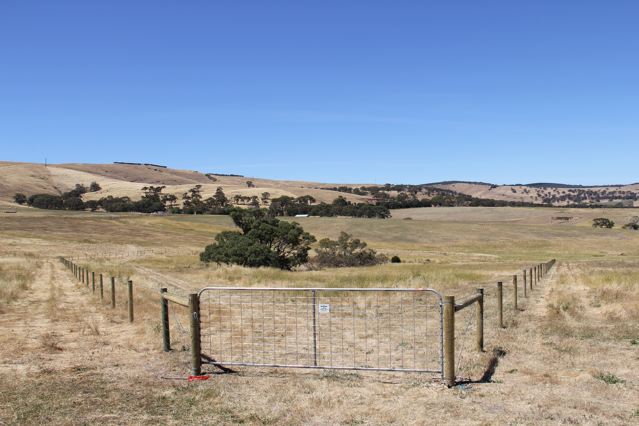
The gate into the top end of the northern revegetation area

While our impact on this landscape has been pretty minimal so far, with the completion of our first phase of fencing, we’ve begun more major infrastructure works. We’ve started by fencing off two big chunks of ground encircling the erosion gullies, surrounding them with a roughly 20-metre buffer zone for future woodland regeneration.

IMG_3231

Neat knots

In a permaculture sense, these patches of ground will be our Zone 5, our minimal-management ‘wilderness’ zones, designed for habitat and ecosystem services such as erosion and salinity control and water filtration. Abutting our western boundary they form a link with the creeks and swamps that feed the Congeratinga River. With these zones now marked onto the landscape we can plan outwards towards zones of increasing management intensity. Continue reading

A Year on the Block

Tags

, , , , , , , ,

TBC2013November marks one year since we began our relationship with this patch of soil, grass and rusty car parts. If the permaculture imperative is to obtain a yield, then the yields of this first year have been largely intangible, but no less real. It has been a year of observing and learning about the land, ourselves and what we can do here. I remember emotions I was feeling about this project a year ago, and I think my terror has been mostly balanced by a sense of calm. Where 12 months ago I was overwhelmed by the scale of our ignorance, now, our ignorance is still largely intact, but I’m more confident in our collective abilities as a family, nested within a community, to unravel the challenges we face. Continue reading

The Bee House

Tags

, , , , , , , , ,

DPP_0004_2When we first dug the post holes for the bee house, it was winter. It was a clear, sunny day, but only 30cm underground it was a river. Now, the soil has hardened again and already cracks are forming where the sun has touched between the tussocks. It is the time of insects: the long grass shimmers with the darting of grasshoppers and butterflies, the red gums are awash with ants and centipedes uncurl in dark, hidden places. It’s a good time to introduce our first livestock – bees – and to finally complete their shelter: the Bee House. Continue reading

Learning the land with ‘The Biggest Estate on Earth’

Tags

, , , , , , ,

In The Biggest Estate on Earth (Allen & Unwin, 2011), historian Bill Gammage describes a detailed vision of Aboriginal land management prior to European colonisation of Australia. While many Australians have a broad sense that “fire-stick farming” was (and is) a tool used by Aboriginal people, The Biggest Estate on Earth begins to fathom how finely tuned Aboriginal fire use was. With fire as one of a suite of tools, Aboriginal people across the Australian continent carved the landscape into a mosaic of ecosystems, each harbouring plants and animals of differing sensitivity to fire, each maintained to maximise ecological diversity and each nested within the other to increase the ease of hunting or harvesting. For Gammage, Aboriginal land management across the continent was directed by three main principles: “ensure that all life flourishes; make plants and animals abundant, convenient and predictable”; and to “think universal, act local”. Continue reading
Our first wet winter

Tags

, , , , , ,

IMG_2852_2_3

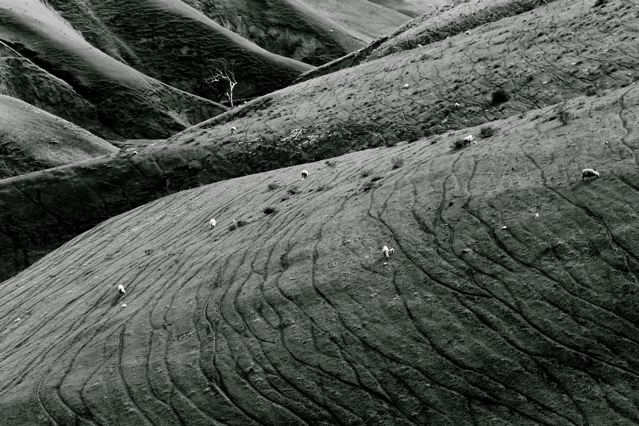
Sheep figuring out the contour, near Sellicks.

I feel like I’ve never really understood winter until this year. When the first rains came, they came hard, revealing slippery, sticky mud and rivulets in unexpected places. The average June rainfall for Second Valley is around 90mm. This year the Bureau of Meteorology recorded over 200mm, and the nearby district of Parawa scored a record-breaking 266mm. Long-dormant erosion gullies were reawoken, creek banks slumped, and everywhere there was the sound of dripping. Now, the days are clearing, the sun has bite and already the kangaroos have joeys in pouch. Here’s some highlights from the wet season. Continue reading