
When we “bought” this land, we thought it was a win-win situation. Despite living more than an hour away with a 6 month old baby, we thought that in the best case scenario we could restore the land and develop it into a flourishing farm business and family home. We also thought that if our plans changed in a worst case scenario, just planting some trees and removing the rubbish in the gullies would increase the value of the land and make it a good investment.
What we had not factored in was the power and connection developed through spending time on land and shaping the future of a piece of land. All the working bees with friends and family, pouring sweat and laughter into increasing biodiversity one hole at a time. Observing new birds and insects previously unnoticed. Gazing at the amazing starscape on a still night around the fire. Gradually figuring out the connections between elements of the ecosystems and life cycles of creatures. Getting to know each inch of the place, seeing the changes of the seasons, and from year to year. And it’s exciting how much there is still to learn!

While there have certainly been times when we have questioned our decisions (particularly when the wind is howling and trees are withering!), I feel that at the moment we are in a place of total contentment, inspiration, and joy at having the privilege to steward this land. The grass is green and some of our worst paddocks are improving in grass diversity and productivity through management decisions. Our trees are growing taller, our shrubs are bushing out, and our sheoak needles are whispering in the wind. Our fig and plum tree are releafing after their winter dormancy. The kangaroo mob has abated, time out working in the sun energises us, and we are witness to processes of water and soil far beyond our control and that hold continuity with the distant past and distant future of this land. This land gives us a healthy sense of perspective at our place in the world, microscopic and very temporary, but able to effect positive change nevertheless.
The recent crop of new books we’ve had in the household have also helped in bringing together some of the disparate observations, ideas and philosophies we’ve had about our work with the land, into some more cohesive strategies for land management.

“Beyond the War on Invasive Species” by Tao Orion has taught us about the important role that weeds play in moving landscapes through ecological succession. Spraying, tilling, and burning all keep landscapes juvenile when all they want to do is move towards greater levels of complexity. This intersected nicely with an observation by the owner of Deep Creek Organics (which we recently toured) that “all weeds have a role to play”. He pointed to cape weed as an example, and the way it has a deep tap root that can access nutrients further down. We see this too with our weediest cracking clay paddocks, where a profusion of wild turnip in previous years has brought up nutrients, which when slashed, adds organic matter and soil cover and allows other grasses to establish. As a result the paddock is looking much healthier. Rather than feeling frustrated with the profusion of “weeds” where we do not want them, we are trying to see them as agents of change in a landscape and not assuming that is for the worst. They also add diversity to our pasture and offer sheep greater choice and health.
Another great read has been “Silvopasture” by Steve Gabriel, which is a handbook for creating landscapes that marry both grass production for grazing and tree/fodder crops (different to “agroforestry” or “farm forestry” which primarily focuses on tree/timber production), with a focus on sequestering carbon. In fact, silvopasture has been identified by Project Drawdown as one of the most effective agricultural strategies for sequestering carbon. In silvopasture systems, tree and shrub species are carefully managed to maximise both grass production and tree crops, both benefiting the other if done well. While we have experimented with woodlots in a few of our paddocks, we have now planned out our first silvopasture paddock to plant out in 2019, integrating Old Man Saltbush as livestock fodder and nurse plant together with various non-grass-inhibiting species of eucalyptus and sheoak for stock shelter, moisture retention, soil stabilising, and eventually firewood and timber. We are really excited about this new direction for our farm, starting with some of our least productive paddocks that are above eroding gullies which we hope will also slow erosion.

I have also really enjoyed “Braiding Sweetgrass” by Robin Wall Kimmerer, who is both a biologist and a native American of the Potawotomi nation. She has some incredible insights into plants as teachers, the importance of gratitude, gifts and reciprocity with the non-human-world, and the awe-inspiring traditional relationships of native American communities with other plant and animal species as well as traditional teachings and stories. Such a powerful book, this passage resonated with our work on the land:
“Despair is paralysis. It robs us of agency. It blinds us to our own power and the power of the earth. Environmental despair is a poison every bit as destructive as the methylated mercury in the bottom of Onondaga Lake. But how can we submit to despair while the land is saying “Help”? Restoration is a powerful antidote to despair. Restoration offers concrete means by which humans can once again enter into positive, creative relationship with the more-than-human world, meeting responsibilities that are simultaneously material and spiritual. It’s not enough to grieve. It’s not enough to just stop doing bad things.
We have enjoyed the feast generously laid out for us by Mother Earth, but now the plates are empty and the dining room is a mess. It’s time we started doing the dishes in Mother Earth’s kitchen. Doing dishes has gotten a bad rap, but everyone who migrates to the kitchen after a meal knows that that’s where the laughter happens, the good conversations, the friendships. Doing dishes, like doing restoration, forms relationships.”

Finally, I have loved “Dawn Again” by Doniga Markegard, a US woman who is a world-renowned wildlife tracker who studied with Jon Young’s Wilderness Awareness School. From tracking she was drawn to permaculture and finally into holistic grazing with an extensive grazing operation in California. The book is her personal journey from childhood to now parenting four children, such an inspirational and affirming read as it also mirrors the evolution of our interests.
I recognise that we have no claims over this land in the way that indigenous peoples do, but I do truly feel that after even a few years of walking and working on this land, we are beginning to have an inkling of what a deep relationship with a landscape can feel like, and a shadow of a sense of how it works. We have entered a bond of reciprocity with the land, and are so grateful for what the land has shared with us.
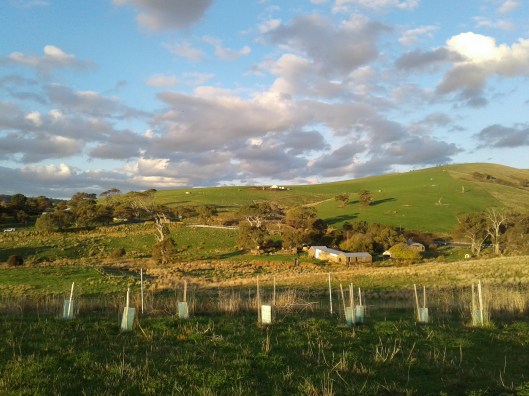

 Yarnauwi Farm